NEWS
About Us

Architects and Planners for Justice in Palestine
UK architects, planners and other construction industry professionals campaigning for a just peace in Israel/Palestine.

DATABASE & REPORTS
Friday
Dec212012

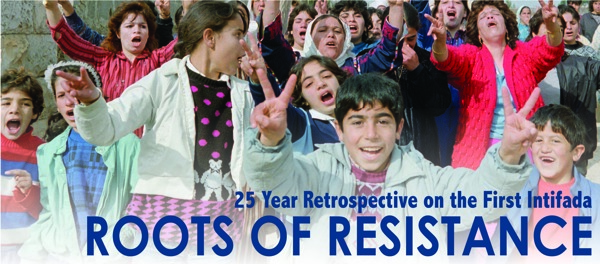
Roots of Resistance: Bringing the uprising home – Advocacy to shift US policy during the first intifada

http://mondoweiss.net/2012/12/roots-of-resistance-bringing-the-uprising-home-advocacy-to-shift-us-policy-during-the-first-intifada.html

by  on December 13, 2012 2

This post is part of the series "Roots of Resistance: 25 year retrospective on the first intifada." Read the entire series here.

In September 1988, when the popular unarmed uprising of the Palestinian people to shake off the Israeli occupation was nine months old, I traveled to Israel’s occupied territories as part of a fact-finding mission.

For two weeks we moved around and between a West Bank and Gaza Strip that had not yet been forcibly separated from each other, and carved up by walls, ‘Israeli-only’ roads and hundreds of checkpoints. We visited hospitals where beds were full of young people and children who had been kneecapped and had their bones broken under Defense Secretary Yitzhak Rabin’s policy of “force, might and beatings.” We participated in peaceful marches that were dispersed by huge quantities of tear gas, rubber bullets, bullets with metal cores and sometimes live ammunition. We watched as small children were chased through the alleys of refugee camps by the soldiers they had taunted with fingers held in V-signs and chants of “PLO! PLO!”

We met with representatives of the hundreds of popular committees that had been set up in every village, refugee camp and town to involve the entire community in activities ranging from growing vegetables and raising chickens, to organizing blood donors, being on the watch for soldiers, covering the walls with slogans of struggle at the risk of being shot by rooftop snipers, providing the needy with food and medicine, and finding ways to surmount the crippling impact of curfews that imprisoned villagers in their homes for days and sometimes even weeks at a time. In the Gaza Strip, we heard speculation that Israel was attempting to divide the Palestinian movement by nurturing a new organization called Hamas, whose slogans were left on the walls while those of Fatah and other PLO factions were immediately expunged.

Everywhere we went, we saw evidence of America’s involvement, from the ‘Made in Pennsylvania’ tear gas canisters that were to cause at least 70 deaths and untold miscarriages during the course of the Intifada to the ‘Made in California’ billy clubs used to break demonstrators’ bones.

On the edge of the village of Beita in the West Bank, we met a woman standing behind a heap of stones that had been her house. She spoke bitterly to us of the 25 years it had taken her to build a home and of the few minutes it took the Israeli army to blow it up.

Why, she asked us, do the Americans continue to pay for the Israeli occupation? “When will the Americans see that we Palestinians are people too?”

Her question was personally life-changing. On my return, I knew I had to do more than write a report and do some public speaking about what I had seen.

My determination to undertake long-term work to inform public opinion and change US policy was bolstered soon after when American eyewitnesses reported that an 11-year-old who was shot by the army in the same village of Beita had been left to bleed on the main street for six hours, while soldiers prevented medical teams and his family from approaching him. By the time he was taken to the hospital, he had bled to death.

There needed to be a way in the United States to get incidents like this to the attention of the public and decision makers. The result was the formation of the Middle East Justice Network which I directed over a seven-year period. We coordinated local activist networks around the country to lobby Congress, informed the public through a bimonthly publication, Breaking the Siege, briefing papers and a Congressional report card, and organized delegations to visit the West Bank and Gaza. We also held well-attended annual conferences. Two of them focused on the Apartheid analogy, and the links between what was happening in South Africa and in Israel/Palestine. Speakers from liberation struggles in both regions were featured in “Apartheid’s Arc and the Palestinian Uprising: Making the Connections” (November 11, 1989) and “From Occupation to Apartheid: Israel, South Africa and the ‘New World Order’” (November 15, 1991).

It is interesting now to reflect on how we functioned in the era before e-mails, YouTube videos and widespread Internet use, when our Action Alerts had to be mailed to our thousands of members and information had to be distilled through frequent visits, faxes and phone calls, and daily on-the-ground reports and publications from a range of Israeli and Palestinian sources, and UN and human rights groups that flooded our postal box. I am drawing upon that trove of information in this remembrance of the first Intifada and our fledgling lobbying efforts.

We often hear the question: “Why can’t Palestinians use nonviolence?” The answer is that they have, since the early years of the 20th century, as Mazin Qumsiyeh has documented in his book Popular Resistance in Palestine: A History of Hope and Empowerment.

Rarely asked is this: What happens when nonviolence is met with extreme violence, and the world (or the part of it that can make a difference) is not watching? If there had been no TV cameras to disseminate images of the brutal beating of Civil Rights Movement marchers on Selma’s Edmund Pettus Bridge, how long would it have taken to get Congress to pass the Voting Rights Act?

The American mainstream media had little interest in giving its readers and viewers more than an occasional glimpse of the Intifada – which Israelis insisted was not nonviolent, because many children and young people were armed with slingshots and stones.

The media had little interest in explaining the context out of which the uprising erupted: what it meant to live under some 1290 military orders in the West Bank and nearly 1,000 in the Gaza Strip which governed every aspect of Palestinian life, determining what Palestinians can read, where they can drive, whether they can whitewash their house or repair a window, plant a tomato or pick wild thyme. Only a few of these orders had been translated into Arabic or made accessible to Palestinian lawyers. One of them, Military Order 378, empowered any soldier to arrest a Palestinian without any reason, and hold him or her for up to 18 days without going before a court. Political assemblies and demonstrations were forbidden. Other “illegal” acts included the flying of Palestinian flags and writing of political graffiti – whether or not this could be shown to pose an imminent security threat.

What made the Israeli military occupation of the West Bank and Gaza arguably unique was its methodical attention to detail and ‘legal’ justifications for blatantly illegal acts, as well as the cumulative weight of its web of bureaucratic regulations, all tending towards a common end – to ensure that Palestinians would never be masters of their own fate, or anything more than transients in their own land.

As the Intifada entered its third year, the West Bank human rights organization Al Haq called it “an expression of collective anger and frustration, a reaction to 20 years of expropriation, denial and oppression. People from all walks of life are involved, participating in a variety of acts of civil disobedience…Our Intifada is an optimistic and unified call for freedom.”

The American media tended not to trust the reports and statistics put forward by Palestinian groups like Al Haq. Conditioned to regard the Israeli occupation as ‘benign’ if it was even on their radar screen, they appeared to be skeptical of the unfolding horror of the repression: the more than a thousand killed by the Israeli army, a quarter of them children, the 115,000 serious injuries – that’s one for every 15 residents; the 40,000 people rendered permanently disabled. According to James Graff’s comprehensive study, Palestinian Children and Israeli State Violence, between December 1987 and December 1989, “one in every 22 children in Gaza has been seriously injured by gunfire, beatings or tear gas. On the West Bank, the ratio is 1:41.” The United States per capita equivalent would be in the order of 1.8 million seriously injured children. An August 1989 bulletin of the Israeli League for Human and Civil Rights stated that there were increasingly cases in which child leaders were being targeted by sharpshooters from ‘special units’ and instantly killed.

Some 75,000 children 12 years and older were arrested during the first three years of the Intifada for throwing stones, and at least 10,000 of them spent years in prison for stone throwing. The reports of how they were treated make harrowing reading. There appeared to be nothing random about the sadistic tortures used against them to get them to give evidence against friends and older brothers and sisters, the beating which left a boy who was deaf, dumb and mentally retarded, “looking like a steak,” the arrest of a seven-year-old boy in Bethlehem for having a box in his bookbag on which a Palestinian flag had been doodled, the detaining and blindfolding of six and seven-year-olds who were held until their parents could find the ‘child bail’ of up to $800 needed to get them out of custody.

The adults fared little better. One in five Palestinian males between the ages of 15 -55 were arrested in the first three years of the Intifada, with over a thousand women arrested on ‘security grounds.’ Military Order 1281 allowed military commanders to administratively detain a Palestinian without charges or trial for renewable terms of up to one year if the commander has ”reasonable cause to believe that reasons of security of the area or public security require that a particular person be detained.” Some 14,000 Palestinians were placed in administrative detention. According to the US State Department’s Country Reports on Human Rights Practices for 1989, a number “appear to have been detained for nonviolent political activities.” The rate at which Palestinians were imprisoned without charge or trial during the first three years of the Intifada was nearly ten times greater than the rate at which South Africans were detained under the State of Emergency of 1985-7.

With arrest and imprisonment, invariably came torture to extract ‘confessions’ and information, or to destroy the spirit and create a cadre of informers. Some of the techniques used in Israeli jails – long-term hooding and stress positions, confinement in the ‘coffin’ or ‘refrigerator,’ severe beatings, sleep deprivation, verbal abuse and humiliation – became incorporated in the ‘enhanced interrogation techniques’ used by the US against its ‘war on terror’ captives. The torture meted out to Palestinians had no age limit.

Other techniques in the Israeli arsenal of repression: the expulsion of Intifada leaders; the two-year-long closure of schools and universities as Israel told Palestinians they could not have their Intifada and education too; and curfews that turned every home into a prison, with families of nine and ten children crammed into one or two poorly ventilated rooms in refugee camps, often with no electricity and water supplies. A ‘curfew breaker’ could be shot, beaten, imprisoned for up to five years and fined $15,000.

Then there were sieges, when towns were entirely sealed off by the army to break resistance. During the near total curfew imposed on the village of Kabatiya during five weeks in July-August 1988, soldiers entered nearly every house, terrorizing and beating people, destroying food and furniture, urinating in water tanks and shooting them full of holes, shooting at people caught outside or trying to dry clothes on the roof. Animals starved and died; crops rotted on the ground.

The people of Kabatiya were being punished for killing a collaborator from nearby Camp Fahmeh, a settlement for collaborators established on an Israeli military base. The residents of Beit Sahour received similar treatment during a two month siege that began in August 1989. Their crime? They refused to pay taxes under the slogan, “No taxation without representation.”

Why this ferocious response to an essentially nonviolent uprising?

One answer was given in an interview which the Israeli journalist Gideon Levy conducted with Col. Zvi Poleg, Commander of the Israeli Defense Forces in the Gaza Strip. Thanks to the late Dr. Israel Shahak, we have the translation of this December 8, 1988 Ha’aretz piece and many other revealing articles from the Hebrew press.

“I ask him, ‘How does a march of a few dozen demonstrators bother you?’ ‘A march is a disturbance of the order,’ he responds. ‘You never know when the organizers of a march will lose control and it will become a big event…’ ‘Why does a PLO flag hanging on an electricity pole disturb you?’ I ask. ‘It is part of our ruling,’ he says. ‘To demonstrate that you are the ruler, that you are in charge of the territory, of the population, of everything everyday, you cannot compromise on even the smallest point.’”

Then there was the dehumanizing racism, which, for many, made killing easy. It was during Col. Poleg’s command that this poem was placed on the wall of a senior officer of the Civil Administration in the Gaza Strip

“Yes, it is true that I hate Arabs

I want to take them off the map.

Yes, this is all (my} work.

My life passes pleasurably

One shoots a bullet and a head is flying…

There are beautiful places in the territories

There is sea and sand and many palms

It is a pity that there are Arabs there too.”

(Ha’aretz, June 16, 1989. Translated by Dr. Israel Shahak).

But some of the most haunting descriptions of the repression of the Intfada came from Israeli soldiers who could not stomach what they were being commanded to do.

There was a report of a “Captain A” being sickened by the new policy to “bring calm to the area” which required soldiers to round up and shackle all the men in a village, take them to an orchard, stuff their mouths with flannel and then carry out the orders:

“To break their arms and legs by clubbing the Arabs; To avoid clubbing them on their heads; To remove their bonds after breaking their arms and legs, and to leave them at the site; To leave one local with broken arms but without broken legs so he could make it back to the village on his own and get help. The mission was carried out as ordered. In the course of carrying it out, most of the wooden clubs were broken.”

(Yossi Sarid, “The Night of the Broken Clubs,” Ha’aretz, May 4, 1989. Translated by Dr. Israel Shahak.)

There was this description of a home invasion written by 23-year-old Pvt. Yehuda Maor:

“We stormed a house and nobody understood why this particular house was chosen…The company commander smashed the window glass and ordered three soldiers to smash the windows around the house…The owner of the house and his wife stood in a corner of the room embracing each other, protecting the little children, trembling with fear. And all the time you heard the soldiers shouting and cursing, some of them laughing a wicked, frightening laughter. You could see them beating people, smashing windows, breaking things for no reason, behaving like beasts…

“I stepped aside, into a dark corner, so that the chaps won’t see me. That they could not see the same soldiers changing uniforms, putting this time black uniforms on, with high black boots, shining, polished, and the same soldiers were also smashing, breaking, cursing, beating, outraged like wild beasts in the streets, inside the houses, in the alleys. I told myself it cannot be. I saw, I swear, that night I saw the Nazis again.”

(Davar, October 20, 1990. Translated by Israel Shahak)

The Nazi allusion appears in a wrenching piece by a young reservist, Ari Shavit, about his time guarding the Gaza Strip’s Ansar II detention camp which was full of teenagers arrested for stone throwing:

“N…an unsentimental Likud supporter, tells anyone who is willing to listen, why this place looks like a concentration camp. I’m like that too…when I simply survey my surroundings…the association burst out of their own accord. And like a believer whose faith is cracking, I find myself going over the list of arguments, the list of differences: There there were crematoria and here there are not, I remind myself. There there was no conflict between the peoples, I remind myself. The Germans were in no danger, and so on and so on.

“Until I catch myself understanding that the problem is not one of similarity….The problem is that there is not enough dissimilarity…

“And maybe the fault lies with the detentions done by the Shabak: almost nightly, after interrogating a number of youngsters to the breaking point, the Shabak passes out a list of the youngster’s friends to the paratroopers…And you see them going to the curfew-bound city at night, to arrest the people who endanger the security of the state. And you see them returning with 15 and 16-year-olds, teeth chattering, eyes popping, often already beaten and manacled. Even S…can’t believe his eyes. ‘We’ve come to this?’ he says…’The Shabak run after children like these?’

“Or perhaps the fault lies with the screams...from this moment forth you will have no rest…because other people – wearing the same uniform as you – are doing things to them that make them scream. They are screaming because your Jewish state, your democratic state, in an institutionalized, systematic manner and definitely legally – your state is making them scream…

“After a day or two at the installation, the people caged behind the wire fences are already a natural sight. The interrogation wing is part of the routine…In the three-and-a-half years of the Intifada, thousands of Israeli citizens in uniform have walked around within these fences, have hard these screams…And the country is silent, prosperous…

“And despite the fact that there is no room at all for comparison…you start to understand some of those other guards, who stood in other places, guarding other people behind other fences. Other guards who heard other screams and didn’t hear a thing…

“It has become impossible any longer to ask, as good Israelis love to ask, ‘Is this what we were educated for?’ Because after 40 months of Intifada, after the Lebanon War, the answer is: apparently so.”

(Ha’aretz Weekend Supplement, May 3, 1991)

At the Middle East Justice Network we endeavored to educate not just the public, but also elected officials about the reasons for the Intifada and how it was being brutally suppressed. If they wouldn’t believe what Palestinians were saying, what about these Israeli voices of conscience?

We often encountered disbelief and an unsettling level of ignorance. Several Members of Congress flatly refused to accept that Israel could be destroying Palestinian homes. At a time when members of the Congressional Black Caucus were pushing for an end to the Israel-South Africa arms connection, not all of them could accept the fact that Israel was engaging in Apartheid practices in its treatment of Palestinians. The US State Department seemed to have a better grasp of things when it wrote in its Country Reports on Human Rights Practices for 1988:

“Jewish settlers in the occupied territories are subject to Israeli law while Palestinians are subject to Israeli military occupation law. Under the dual system of governance applied to Palestinians and Israelis, Palestinians are treated less favorably than Jewish settlers in the same areas on a broad range of issues, such as the right to legal process, rights of residency, freedom of movement, sale of crops and goods, land and water use, and access to health and social services.”

As we built a network of legislative district coordinators around the country, we embarked on efforts to get Congress to take steps (even baby ones) to acknowledge that there was more than one side to the story. We encouraged Members to support the resolution by Rep. Howard Nielson (R-UT) calling on Israel to reopen Palestinian schools. On the day it was passed (July 17, 1989) Israel declared it would open the schools in the West Bank within two weeks.

Next, we helped Rep. Nielson get more than 80 co-sponsors on a concurrent resolution demanding that Palestinian universities be opened. It didn’t have the clout of the European Parliament vote to suspend all scientific cooperation with Israel until the universities were reopened, but it was a small indication, we hoped, of larger things to come.

Those larger opportunities arrived when Senator Bob Dole in a January 16, 1990New York Times Op-Ed recommended a 5% reduction in US aid to Israel (as well as to Egypt, Philippines, Turkey and Pakistan), which the first Bush Administration reportedly regarded as a “trial balloon.” In a January 20th interview on CNN, Senator Dole stated that the total aid we have given Israel “amounts to about $10,000 for every man, woman and child in Israel – which is a fairly substantial amount of aid.”

We took up the role of educating elected officials and the public about how US aid to Israel was in violation of the 1961 Foreign Assistance Act prohibiting military and economic assistance to any country engaged in a “consistent pattern of gross violations of internationally recognized human rights” and the US Anti-Apartheid Act of 1986 that stipulated that US allies that break the UN arms embargo on South Africa should not receive US military assistance. We hoped that such a cut would be a signal that American taxpayers would not indefinitely subsidize Israel’s military occupation.

The subsequent battle over Israel’s request for $10 billion in loan guarantees to settle Russia’s Jews opened the door to new lobbying opportunities as it raised the possibility that the Bush (Sr.) Administration would use economic leverage to force Israel’s Prime Minister Yitzhak Shamir to abandon his settlement expansion program. With Secretary of State James Baker telling the House Foreign Affairs Subcommittee on May 22, 1991 that “I don’t think that there is any bigger obstacle to peace than the settlement activity that continues not only unabated but at an enhanced pace,” some Members of Congress seemed prepared to go along, no doubt reassured by poll results that showed that the majority (and in one poll 86%) of the American public agreed with the Administration.

Senator Robert Byrd (D-WV) declared on October 19, 1990: “I did not cast my votes so that Israel could disregard longstanding United States policy on the settlements and use those funds to construct housing in the occupied territories,“ while Rep. David Obey (D-WI), chairman of the Appropriations Subcommittee on Foreign Operations, stated on February 6, 1991: “How much more of our foreign aid budget should the Middle East be allowed to devour? My answer is none, until those dollars are provided in the context of a sweeping re-evaluation of basic policy.”

Can you imagine statements like these coming out of the current Congress?

The campaign to tell Israel that it cannot have loan guarantees and settlement construction too caused the Israeli electorate to abandon Prime Minister Shamir in June 1992. The new prime minister was Yitzhak Rabin, the architect of “force, might and beatings.” Eventually, Israel got its loan guarantees without abandoning its settlement project.

The Intifada ebbed but the killing of protestors continued, as did the mass arrests, house raids and demolitions, and expulsions. Nine desultory rounds of a “peace process” kicked off by the Madrid Conference in October 1991 ended in May1993 with the parties being unable to agree on a statement of principles. Nothing in a draft produced by the US suggested that the Americans were prepared to pressure for Israeli withdrawal from the territories and an end to the occupation.

Then came the Oslo surprise and Yasser Arafat’s announcement to Palestinians on September 16, 1993 that “they have found a valuable friend in the White House.” We at the Middle East Justice Network took a close look at the Declaration of Principles and subsequent agreements and had our doubts. We described what was on offer as “Apartheid with Joint Patrols.”

The situation today could hardly be more bleak. But when I reflect on my first-hand experience of the creative resilience of the first Intifada, I know that if the arc of history does indeed bend toward justice, the Palestinian people shall surely overcome one day.

Here is how the late Mahmoud Darwish described their irrepressible spirit:

They shut me in a dark cell.
My heart glowed with sunny torches.
They wrote my number on the walls.
The walls transformed to green pastures.
They drew the face of my executioner.
The face was soon dispersed
With luminous braids.
I carved your map with my teeth upon the walls
And wrote the song of fleeting night.
I hurled defeat to obscurity
And plunged my hands
Into rays of light.
They conquered nothing.
Nothing.
They only kindled earthquakes.

- "The Reaction," Mahmoud Darwish

**********************************************************************************
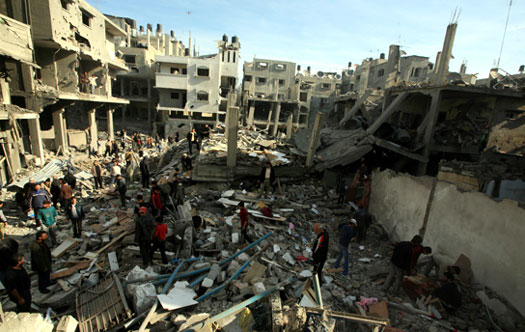
Saturday
Dec012012

Short Cuts: The Book of Destruction in Gaza

Eyal Weizman       London Review of Books   December 2012

http://www.lrb.co.uk/v34/n23/eyal-weizman/short-cuts 

 fledgling.typepad.com - 525 × 332    

In the course of the eight-day aerial bombardment of Gaza by Israel – using drones, F-16s and Apache helicopters – more than 1350 buildings were hit. They included military depots, which are considered legitimate targets under international humanitarian law. But the police stations, TV stations, a local healthcare centre, ministries, road tunnels and a bridge that were also targeted are legally protected as civilian infrastructure. To justify their destruction, Israel argued that ‘they belong to a terrorist entity.’ This is an argument that would render all public buildings and physical infrastructure in the Strip legitimate targets: it is not accepted by international lawyers outside Israel.

Israel’s attempt to provide any sort of legal defence at all, however tenuous, is a response to the Goldstone Report, which alleged (before Goldstone himself recanted) that both the Israeli military and Hamas had committed war crimes during the 2008-9 conflict, and that Israel might even be guilty of ‘crimes against humanity’. During the Goldstone storm, in a speech delivered at an Israeli security institute, Netanyahu called organisations that claimed to support the principles of human rights and international law the third strategic threat to Israel’s security – third after Iran and Hizbullah. Israeli think-tanks, like some of their Western counterparts, now refer to this ‘third strategic threat’ of legal action against state militaries as ‘lawfare’: the use of international law as a weapon by a non-state party, to make up for its weakness on the field of combat.

Mindful of the danger of further exposure to international legal action, during Operation Pillar of Defence Netanyahu ordered the military to exercise restraint so as to avoid the level of destruction seen in 2008-9. Israeli experts in international humanitarian law were more closely involved than they ever have been before in the planning of the attacks, and the military repeatedly proclaimed its commitment to minimising harm to civilians. The number of casualties was much lower than during Operation Cast Lead, when ten times as many Palestinians were killed, though as the operation approached its end the number of casualties rose: as the list of targets was depleted, the air force had no choice but to drop bombs on more populous neighbourhoods, with a higher risk of collateral damage.

But Israel is no longer content merely asserting that its aerial bombardments are justified under international law. It has begun to experiment with new kinds of bombing. After the 2008-9 attack, human rights advocates undertook an investigation using techniques associated with the new field of ‘forensic architecture’. In so doing they discovered the traces of a new Israeli strategy: small-scale craters caused by impacts on what had been the roofs of destroyed buildings. The Israeli military let it be known that it was using this tactic – known as ‘knock on the roof’ – again during Operation Pillar of Defence. It involves firing low-explosive ‘teaser’ bombs or missiles onto houses designated for destruction, with the intention of making an impact serious enough to scare the inhabitants into fleeing their homes before they are destroyed completely.

Israel makes much of the fact that it always tries to warn civilian inhabitants of impending bombings. The new procedure is a twist on the established ‘knock on the door’ method, which involved telephoning a house – with a recorded message, or using an Arabic-speaking air-force operator – to inform the inhabitants that in a few minutes the building would be destroyed. Sometimes phones that had been disconnected for months because the bill hadn’t been paid were suddenly reactivated in order to relay these warnings. According to the Israeli military, during the last 24 hours of Pillar of Defence, thousands of such calls were made to residents of Gaza, warning them of incoming strikes. (Israel can penetrate Gaza’s communication networks so easily because its telephone networks and internet infrastructure are routed through Israeli servers, which has advantages both for the gathering of intelligence and the delivery of propaganda.)

Of course, many inhabitants of Gaza don’t have a landline or a mobile phone. In these cases, an IDF spokesperson recently explained, the military’s legal experts recommend the use of leaflets to encourage people to leave their houses before they are destroyed. Teaser bombs are just another means of sending a warning. In 2009, an IDF lawyer said: ‘People who go into a house despite a warning do not have to be taken into account in terms of injury to civilians … From the legal point of view, I do not have to show consideration for them.’ To communicate a warning can indeed save a life. But the strategy is also aimed at changing the legal designation of anyone who is killed. According to this interpretation of the law, if a warning has been issued, and not heeded, the victim is no longer a ‘non-combatant’ but a voluntary ‘human shield’. In this and other cases, the laws of war prohibit some things but authorise others. This should give pause to those who have protested against Israel’s attack only in the name of the law.

We will learn more about the way Pillar of Defence was conducted when, over the coming weeks, it becomes possible to start reading the rubble. Some of what we know about the 2008-9 assault comes from an archive – the Book of Destruction – compiled by the Hamas-run Ministry of Public Works and Housing. The archive contains thousands of entries, each documenting a single building that was completely or partly destroyed, recording everything from cracked walls in houses that still stand, to complete ruins. The ministry will no doubt put together a new archive following the latest attack. Its list will be a close parallel to the one contained in a document owned by the Israeli military. This is the Book of Targets in Gaza, a thick blue folder that the outgoing chief of staff, Gabi Ashkenazi, who presided over Operation Cast Lead, passed to his successor in a televised ceremony at the beginning of 2011: ‘I want to hand over something I carry with me all the time,’ he announced.

Now that the bombing is over, evidence will be accumulated (and allegations made and contested), not only by speaking to survivors and witnesses but by using geospatial data, satellite imagery of destroyed buildings and data gathered in on-site investigations. But investigation is difficult: in Gaza ruins are piled on ruins, and it isn’t easy to tell them apart. The wars of 1947-49, the military incursions of the 1950s, the 1956 war, the 1967 war, the 1972 counterinsurgency in the refugee camps, the first intifada of 1987-91, the waves of destruction during the second intifada of the 2000s, and now the two attacks of 2008-9 and 2012, have each piled new layers of rubble on top of those produced by their predecessors.

The visible ruin is an important symbol in the public display of occupation and domination: it demonstrates the presence of the colonial power even when the colonist is nowhere to be seen. Before it withdrew from Gaza in 2005, Israel demonstrated its control over the enclave by means of its settlements. (In 1980, Ariel Sharon, then minister in charge of the settlements, said he wanted ‘the Arabs to see Jewish lights every night no more than five hundred metres away’.) After the military relocated to the Strip’s perimeter and bulldozed the settlements, inaugurating this new era of colonialism, the destroyed buildings – standing like monuments, unrepaired, unrepairable – became the most significant visual affirmation of Israel’s domination.

But Israel’s real power over Gaza is invisible. It is the ability of the Israeli air force to maintain a perpetual ‘surveillance and strike’ capability over Gaza – drones can stay in the air around the clock – that made the territorial withdrawal possible. Together with its control of the Gazan subsoil – manifested in the robbing of much of the water from coastal aquifers – and over the airwaves, including the use of electromagnetic jamming technology, all that is left for the inhabitants of Gaza is the thin surface of the earth that is sandwiched between Israeli-controlled zones. No wonder they try to invade the space below and above them with tunnels and rockets.

*******************

 is an architect and director of the Centre for Research Architecture at Goldsmiths, University of London. His recent books include The Least of All Possible Evils: Humanitarian Violence from Arendt to Gaza.

--------------------------------------------------------------------------------------------------------------------------------

Saturday
Dec012012

Why Israel Didn’t Win by Adam Shatz

http://www.lrb.co.uk/v34/n23/adam-shatz/why-israel-didnt-win

The London Review of Books    

The fighting will erupt again, because Hamas will come under continued pressure from its members and from other militant factions, and because Israel has never needed much pretext to go to war. In 1982, it broke its ceasefire with Arafat’s PLO and invaded Lebanon, citing the attempted assassination of its ambassador to London, even though the attack was the work of Arafat’s sworn enemy, the Iraqi agent Abu Nidal. In 1996, during a period of relative calm, it assassinated Hamas’s bomb-maker Yahya Ayyash, the ‘Engineer’, leading Hamas to strike back with a wave of suicide attacks in Israeli cities. When, a year later, Hamas proposed a thirty-year hudna, or truce, Binyamin Netanyahu dispatched a team of Mossad agents to poison the Hamas leader Khaled Meshaal in Amman; under pressure from Jordan and the US, Israel was forced to provide the antidote, and Meshaal is now the head of Hamas’s political bureau – and an ally of Egypt’s new president, Mohamed Morsi.

Operation Pillar of Defence, Israel’s latest war, began just as Hamas was cobbling together an agreement for a long-term ceasefire. Its military commander, Ahmed al-Jabari, was assassinated only hours after he reviewed the draft proposal. Netanyahu and his defence minister, Ehud Barak, could have had a ceasefire – probably on more favourable terms – without the deaths of more than 160 Palestinians and five Israelis, but then they would have missed a chance to test their new missile defence shield, Iron Dome, whose performance was Israel’s main success in the war. They would also have missed a chance to remind the people of Gaza of their weakness in the face of Israeli military might. The destruction in Gaza was less extensive than it had been in Operation Cast Lead, but on this occasion too the aim, as Gilad Sharon, Ariel’s son, put it in theJerusalem Post, was to send out ‘a Tarzan-like cry that lets the entire jungle know in no uncertain terms just who won, and just who was defeated’.

Victory in war is not measured solely in terms of body counts, however. And the ‘jungle’ – the Israeli word not just for the Palestinians but for the Arabs as a whole – may have the last laugh. Not only did Hamas put up a better fight than it had in the last war, it averted an Israeli ground offensive, won implicit recognition as a legitimate actor from the United States (which helped to broker the talks in Cairo), and achieved concrete gains, above all an end to targeted assassinations and the easing of restrictions on the movement of people and the transfer of goods at the crossings. There was no talk in Cairo, either, of the Quartet Principles requiring Hamas to renounce violence, recognise Israel and adhere to past agreements between Israel and the Palestinian Authority: a symbolic victory for Hamas, but not a small one. And the Palestinians were not the only Arabs who could claim victory in Cairo. In diplomatic terms, the end of fighting under Egyptian mediation marked the dawn of a new Egypt, keen to reclaim the role that it lost when Sadat signed a separate peace with Israel. ‘Egypt is different from yesterday,’ Morsi warned Israel on the first day of the war. ‘We assure them that the price will be high for continued aggression.’ He underscored this point by sending his prime minister, Hesham Kandil, to Gaza the following day. While refraining from incendiary rhetoric, Morsi made it plain that Israel could not depend on Egyptian support for its attack on Gaza, as it had when Mubarak was in power, and would only have itself to blame if the peace treaty were jeopardised. After all, he has to answer to the Muslim Brotherhood, Hamas’s parent organisation, and to the Egyptian people, who are overwhelmingly hostile to Israel. The Obama administration, keen to preserve relations with Egypt, got the message, and so apparently did Israel. Morsi proved that he could negotiate with Israel without ‘selling out the resistance’, in Meshaal’s words. Internationally, it was his finest hour, though Egyptians may remember it as the prelude to his move a day after the ceasefire to award himself far-reaching executive powers that place him above any law.

That Netanyahu stopped short of a ground war, and gave in to key demands at the Cairo talks, is an indication not only of Egypt’s growing stature, but of Israel’s weakened position. Its relations with Turkey, once its closest ally in the region and the pillar of its ‘doctrine of the periphery’ (a strategy based on alliances with non-Arab states) have deteriorated with the rise of Erdogan and the AKP. The Jordanian monarchy, the second Arab government to sign a peace treaty with Israel, is facing increasingly radical protests. And though Israel may welcome the fall of Assad, an ally of Hizbullah and Iran, it is worried that a post-Assad government, dominated by the Syrian branch of the Muslim Brothers, may be no less hostile to the occupying power in the Golan: the occasional rocket fire from inside Syria in recent days has been a reminder for Israel of how quiet that border was under the Assad family. Israeli leaders lamented for years that theirs was the only democracy in the region. What this season of revolts has revealed is that Israel had a very deep investment in Arab authoritarianism. The unravelling of the old Arab order, when Israel could count on the quiet complicity of Arab big men who satisfied their subjects with flamboyant denunciations of Israeli misdeeds but did little to block them, has been painful for Israel, leaving it feeling lonelier than ever. It is this acute sense of vulnerability, even more than Netanyahu’s desire to bolster his martial credentials before the January elections, that led Israel into war.

Hamas, meanwhile, has been buoyed by the same regional shifts, particularly the triumph of Islamist movements in Tunisia and Egypt: Hamas, not Israel, has been ‘normalised’ by the Arab uprisings. Since the flotilla affair, it has developed a close relationship with Turkey, which is keen to use the Palestinian question to project its influence in the Arab world. It also took the risk of breaking with its patrons in Syria: earlier this year, Khaled Meshaal left Damascus for Doha, while his number two, Mousa Abu Marzook, set himself up in Cairo. Since then, Hamas has thrown in its lot with the Syrian uprising, distanced itself from Iran, and found new sources of financial and political support in Qatar, Egypt and Tunisia. It has circumvented the difficulties of the blockade by turning the tunnels into a lucrative source of revenue and worked, with erratic success, to impose discipline on Islamic Jihad and other militant factions in the Strip. The result has been growing regional prestige, and a procession of high-profile visitors, including the emir of Qatar, Sheikh Hamad bin Khalifa al-Thani, who came to Gaza three weeks before the war and promised $400 million dollars to build housing and repair roads. The emir did not make a similar trip to Ramallah.

Hamas’s growing clout has not gone unnoticed in Tel Aviv: cutting Hamas down to size was surely one of its war aims. If Israel were truly interested in achieving a peaceful settlement on the basis of the 1967 borders – parameters which Hamas has accepted – it might have tried to strengthen Abbas by ending settlement activity, and by supporting, or at least not opposing, his bid for non-member observer status for Palestine at the UN. Instead it has done its utmost to sabotage his UN initiative (with the robust collaboration of the Obama administration), threatening to build more settlements if he persists: such, Hamas has been only too happy to point out, are the rewards for non-violent Palestinian resistance. Operation Pillar of Defence will further undermine Abbas’s already fragile standing in the West Bank, where support for Hamas has never been higher.

Hardly had the ceasefire come into effect than Israel raided the West Bank to round up more than fifty Hamas supporters, while Netanyahu warned that Israel ‘might be compelled to embark’ on ‘a much harsher military operation’. (Avigdor Lieberman, his foreign minister, is said to have pushed for a ground war.) After all, Israel has a right to defend itself. This is what the Israelis say and what the Israel lobby says, along with much of the Western press, including the New York Times. In an editorial headed ‘Hamas’s Illegitimacy’ – a curious phrase, since Hamas only seized power in Gaza after winning a majority in the 2006 parliamentary elections – the Times accused Hamas of attacking Israel because it is ‘consumed with hatred for Israel’. The Times didn’t mention that Hamas’s hatred might have been stoked by a punishing economic blockade. It didn’t mention that between the start of the year and the outbreak of this war, 78 Palestinians in Gaza had been killed by Israeli fire, as against a single Israeli in all of Hamas’s notorious rocket fire. Or – until the war started – that this had been a relatively peaceful year for the miserable Strip, where nearly three thousand Palestinians have been killed by Israel since 2006, as against 47 Israelis by Palestinian fire.

Those who invoke Israel’s right to defend itself are not troubled by this disparity in casualties, because the unspoken corollary is that Palestinians do not have the same right. If they dare to exercise this non-right, they must be taught a lesson. ‘We need to flatten entire neighbourhoods in Gaza,’ Gilad Sharon wrote in the Jerusalem Post. ‘Flatten all of Gaza. The Americans didn’t stop with Hiroshima – the Japanese weren’t surrendering fast enough, so they hit Nagasaki too.’ Israel shouldn’t worry about innocent civilians in Gaza, he said, because there are no innocent civilians in Gaza: ‘They elected Hamas … they chose this freely, and must live with the consequences.’ Such language would be shocking were it not so familiar: in Israel the rhetoric of righteous victimhood has merged with the belligerent rhetoric – and the racism – of the conqueror. Sharon’s Tarzan allusion is merely a variation on Barak’s description of Israel as a villa in the jungle; his invocation of nuclear war reminds us that in 2008, the deputy defence minister Matan Vilnai proposed ‘a bigger holocaust’ if Gaza continued to resist.

But the price of war is higher for Israel than it was during Cast Lead, and its room for manoeuvre more limited, because the Jewish state’s only real ally, the American government, has to maintain good relations with Egypt and other democratically elected Islamist governments. During the eight days of Pillar of Defence, Israel put on an impressive and deadly fireworks show, as it always does, lighting up the skies of Gaza and putting out menacing tweets straight from The Sopranos. But the killing of entire families and the destruction of government buildings and police stations, far from encouraging Palestinians to submit, will only fortify their resistance, something Israel might have learned by consulting the pages of recent Jewish history. The Palestinians understand that they are no longer facing Israel on their own: Israel, not Hamas, is the region’s pariah. The Arab world is changing, but Israel is not. Instead, it has retreated further behind Jabotinsky’s ‘iron wall’, deepening its hold on the Occupied Territories, thumbing its nose at a region that is at last acquiring a taste of its own power, exploding in spasms of high-tech violence that fail to conceal its lack of a political strategy to end the conflict. Iron Dome may shield Israel from Qassam rockets, but it won’t shield it from the future.

23 November 2012


Monday
Nov052012

Wall and Tower: The Mold of Israeli Adrichalut

Wall and Tower: The mold of Israeli Adrikhalut


http://babelarchitectures.blogspot.co.uk/2008/12/wall-and-tower-mold-of-israeli.html

Sharon Rotbard        17 December 2008

Architecture and Adrikhalut

The Jewish settlement project over the past century in the "Eretz Israel" (The Land of Israel) has given birth to two architectural traditions: Eretz-Israeli Architecture, and Israeli Adrikhalut.
Eretz-Israeli Architecture refers to architecture made by Jews in the territories of Eretz-Israel (“The Land of Israel”, alias “Palestine”) before the declaration of The State of Israel. Israeli Adrikhalut is an architectural tradition of Hebrew speaking Jews in the territories of State of Israel, the West Bank and the Palestinian Authority after the declaration of The State of Israel.

The distinction between those two traditions is chronological and political, but also linguistic: the evolution from one to another required a sharp move from a European architectural culture to a Hebrew, invented one.
While the architect, as Loos said, is “a builder who learned Latin”, the adrikhal that already had forgotten his foreign languages, in many cases didn’t even speak Hebrew properly. And Hebrew too, was still something to invent.

Apparently, “Architecture” and “Adrikhalut” are synonymous and are in use commonly and sometimes simultaneously. Thus, the Technion in Haifa forms “Architects” and the Tel Aviv University forms “Adrikhals”, and in addition to the historical Union of Israeli Architects, there is today a new Association of Adrikhals (the famous IAUA). Despite their foreign origins, Greek and Accadian, and the fact that both of them are included in the Hebrew dictionary, the use of “Adrikhalut” is more common nowadays and is perceived as more “Hebrew” than the other. In a strange manner, the meanings of “Architect” and “Adrikhal” are quite opposite and reveal two very different agendas about the role of the architect and its relationships with the physical reality: while the Greec Archi-Tect pretends to be the proud “Master of the Tectonics”, the Acadian Ard-Heikhal is occupied in a much more humble role as the “Slave of the Palace”.

Masters and Servants
The uniqueness of the Israeli condition is revealed by the difference between masters and slaves, between Architecture and Adrikhlut. If any planned physical reality is produced in three dimensions, the political, the urban and the architectural, architecture is no less political than urban. Nevertheless, architecture’s relationships with politics depend on its ability to define itself independently as an autonomous discipline, to impose its own agenda and to realize it physically. While acts of modern architecture were being formulated throughout the western world under the illusion of their autonomy, and were structured in a complex relationship between architectural theory and architectural practice, in Israel they were governed primarily by their political circumstances and significances. Comparing the western architecture that had the luxury to cover the political under layers of books and manifestos, in Israel it is impossible to ignore its simple, concrete truths.

The most significant aspect of both Israeli architectural traditions, at once most evident yet so well concealed, is its political dimension. In Israel, just like war, architecture is a continuation of politics through other means. Every act of architecture executed by Jews in Israel is in itself an act of Zionism, whether intentional or not. The political program of ‘building the Land of Israel’ is a fundamental, albeit often latent, component of every building in Israel and the political facts it creates are often more dominant and conclusive than any stylistic, aesthetic, experiential or sensual impact they may have.

Renew, settlement and construction of the new Jewish State have been the declared central goals of the Zionist movement and that includes also its architectural traditions. The new architecture, the new house and the new town were the site and the tool by which the project of settling the Jewish People in the Land of Israel was realized. They were means of attaining territorial objectives, means of deterrence, an industry for the fabrication of political facts. Building the Land of Israel became the central value and key metaphor of the new national ethos: “we came to this land to build and to be built” – sang the pioneers of the twenties. In Israel, building is an educational tool, an official language, an ideology.

This dictated to the Eretz-Israeli architect and much more to the Israeli adrikhal, a paradoxical list of priorities, according to which, political ideology and architectural theory merge, depend on each other, confront one another, hide and are hidden one from the other. Every practicing architect in Israel is confronted with a situation in which distinctive ‘architectural’ dilemmas are infused with critical political implications.
From its inception, the Zionist movement used the means provided by modern architecture to create its places. Both of them were seeking a new place: the first needed one, and the latter strove to create one. As an extension of the European debate of modern architecture, Eretz-Israeli architecture had managed to keep a decent appearance of a normal, western modern architectural tradition. But inspite (and maybe because) this normal appearance, one must remember that in the Middle East, there is nothing more political than normality, and that normality, westhood and modernity have always been the Zionist movement’s most powerful strategic weapons.

Since the declaration of the State of Israel, architecture has been openly mobilized. The new Hebrew speaking “native” tradition, Israeli adrikhalut, had to provide answers for the political needs of the times (to conquer territories, to spread populations, to house immigrants) and, if possible, to proclaim itself as doing so. Israeli adrikhals at their best have been true servants of the palace, serving the Zionist project to a varying degree of integrity, humility, dedication and responsibility, as they attempted to allow political ideology to infiltrate through the architectural forms, and simultaneously enabled architectural doctrines to express themselves through programs inspired or even dictated by politics. In Israel, political ideology and architectural doctrine are dependent on one another and are in a constant and complex dialogue of justification and argumentation. The architectural dimension of architecture – that cultural or spiritual aura of the built object and the added value of the act of building – served at its best as a mere accessory, and at its worst as pure camouflage. In any case, the Israeli adrikhal never had much time to read - the theoretical debates of western architecture have been pushed to the sidelines, giving place for an intensive practice in which any reflexive activity could be considered as almost subversive. The “architectural” dimension of the architectural practice was transformed, in most cases, from the inspiration that imbues a building with meaning into an appendix, a superfluous addition that is used as a pretext, a justification, a cover-up.

Besides relinquishing the universal viewpoint held by Western architects (and Eretz-Israeli architects) that had been rooted in the dialectics between theory and practice, the defining essence of Israeli adrikhalut is rooted between politics and architecture; this is where its dilemmas, its blind spots, and its paradoxes are to be found. Israeli adrikhalut produces impressive architectural objects but lacks a reflexive, comprehensive view of itself; mobilized by the political ideologies it establishes facts cast in concrete that are inherently political, but entirely lacks political awareness.

The Settlement Offensive

Although dated from the period of the Eretz-Israeli architectural tradition, the Homa Umigdal (“Wall and Tower”) settlements in the thirties were a first expression of a Jewish native architectural tradition, Adrikhalut. As an architectural phenomenon that was initiated and conducted almost “without architects”, in the service of political objectives Homa Umigdal was a true realization of the concept of Adrikhalut, and certainly the most direct answer to the palace’s demands.

Homa Umigdal was a response to the “Great Arab Mutiny” that outburst in Palestine/Eretz-israel in April 1936. The mutiny started with riots in Jaffa (9 Jews were lynched and dozens were wounded[1]), followed by a general strike. It included economical measures such as the boycott of commercial and the banning of any real-estate transaction with Jews, and organized para-military activities. The “Great Arab Mutiny” was the most violent reaction of the local Arab population to the Zionist project and certainly a first political organized expression of a new Palestinian identity.

For the Jewish population and especially for the Zionist organizations, to whom the mutiny was known simply as “The Events”, the mutiny offered a golden opportunity to destroy the Arab economy and to progress even faster towards a Jewish state: in Tel-Aviv, the result of the Arab embargo on Jewish ships in Jaffa port was the erection of a new port while the boycott of commercial transactions of fruits and vegetables gave reason to the establishment of two new markets.

Facing the Arab resistance to Jewish settlement in remote parts of the country, and the growing difficulties to purchase lands and to settle them, the Zionist organizations elaborated a new strategy of a coordinated “Settlement Offensive” all over the country. The idea was to establish in the shortest period of time, a chain of new settlements that would create a Jewish continuum and define the future borderline of the State of Israel. This continuum took the form of the letter “N” placed in the valleys[2]: from the northern point of the Jordan Valley to Beit Shean Valley, to the Yizrael Valley, and throughout the Litoral plain, to the Negev desert. To realize the “Settlement Offensive” strategy, the main tactical tool was Homa Umigdal – Wall and Tower.

Wall and Tower System
 
 
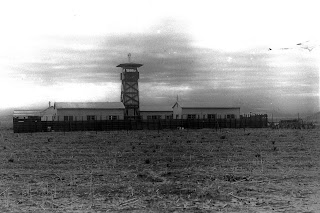
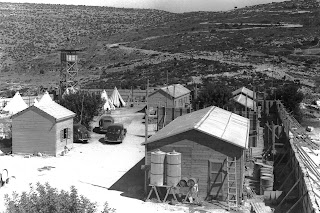
Wall and Tower is a system of settlement seemingly defensive but essentially of offensive form invented in 1936 by the members of Kibbutz Tel-Amal, (today Kibbutz Nir-David) in Beit-Shean valley. The invention was attributed to the Kibbutz member Shlomo Gur,[3] and was developed and encouraged by the architect Yohanan Ratner.[4]

From the start, the objective of this communal and fortified type of settlement was to seize control of land that had been officially purchased by the KKL-JNF[5] but could not be settled upon.

The system was based on the hasty construction of a wall made of pre-fabricated wooden molds filled with gravel and surrounded by a barbed wire fence. All in all, the enclosed space formed a 35m by 35m yard. Within this enclosure were set up a pre-fabricated wooden tower that commanded the view of the surrounding area and four shacks that were to house a ‘conquering troop’ of forty people. Between the years 1936 and 1939, some fifty- seven such outposts were set up throughout the country that rapidly developed into permanent collective settlements of the Kibbutz and Moshav type.

The primary tactical requirement for the Wall and Tower settlement had to meet several conditions: it had to be planned in such a way that it could be constructed within one day, and later, even within one night, that it could protect itself for as long as it would take for backup to arrive, and it had to be situated within eyesight of other settlements and with accessibility for motor vehicles.

Tel Amal
The first Wall and Tower outpost was erected at the site that later became Kibbutz Tel-Amal in the Yizrael Valley.[6] The members of the kibbutz had formed a community in Tel-Aviv and were searching for land on which to settle. When several of them arrived at Kibbutz Beit Alfa, they realized that the members of that kibbutz wanted to establish another settlement east of their own, where there was a large Bedouin encampment, so that it would not be the most remote settlement. Although the land surrounding Kibbutz Beit Alfa had been bought by the KKL-JNF from Arab landowners in Beirut, it was being used by the Bedouins as their pasture grounds every winter and could not be settled upon. The members of Kibbutz Tel-Amal set up an encampment near Beit Alfa and began to cultivate the land. With the outbreak of the Arab Rebellion of April 1936, their attempts at settling the land were thwarted when the Bedouins set fire to their camp. These attacks led the people of Kibbutz Tel-Amal to initiate lengthy discussions with the residents of Beit Alfa and other settlements in the area regarding possible defense methods against the Bedouins, who were armed with ‘shiny British rifles.’ A formula was devised for the erection of four shacks surrounded by sandbags. This promptly developed into double walls built as molds and filled in with gravel up to the height of the windows. ‘In addition to that we aimed to erect observation posts in the corners’ – so wrote one of the members, Yehezkel Frenkel, ‘and near the huts to dig defensive fortifications.’[7] The solution generated two objections: the first declared that this does not provide sufficient defense in the area in between the huts, the second, voiced by the carpenters, maintained that the walls would not withstand the pressure of the gravel. Following further calculations it became apparent that with little additional cost it might be possible ‘to surround the huts with a yard and around the yard erect a wall and an observation tower with a light projector… [to] make a double mold and fill it with gravel.’ Shlomo Gur went to consult Yohanan Ratner, and returned with a ‘a drafted plan of a rectangular wall with four defensive positions at its corners’ (Frenkel). The proposal was transferred to the Regional Committee, which accepted the idea and declared that ‘we are at the beginning of a new era of fortified walls, in spite of our neighbors’ dismay.’
Following the success of the Tel-Amal experiment, Wall and Tower operations were carried out throughout the country. Tel-Amal did not remain for long the farthest outpost – Kibbutz Sdeh-Nahum was set up and within a year dozens of such outposts were set up throughout the country, ‘sometimes seven outposts in a single night,’ recounts Gur, who participated in the organization of some fifty such operations. The nocturnal expeditions were always assisted by existing settlements in the area, and were coordinated by the Zionist Leadership. 
Sustainable Occupation


From any possible military or political aspect, the historical importance of the settlement offensive and of the Wall and Tower settlements was immense: there is no doubt that without those 57 Wall and Tower outposts spread in strategic places in Galilee, the Jordan Valley, Yizrael Valley and the Neguev, the fate of the state of Israel in 1948 would have been entirely different. The Wall and Tower outposts set along the “N” plan materialized the borderlines of the State of Israel until 1967 and shaped its only consensual form.
The success of the settlement offensive defined the state’s strategy in the days to come. Settlement has became one of the IDF’s main missions and soon after the army’s constitution in 1948, Ben-Gurion created a special military unit (“NAHAL” - Pioneering Fighting Youth) combining combat military activities and settlements tasks all over the country. As he explained to the soldiers in the new unit’s inaugurating parade, the strategy was clear: “Not with silent stone fortifications but with the labor and creation of a living human wall, the only wall that is able to resist the enemy’s weaponry. The only sustainable occupation resides in building.”[8]

History

Although as a metaphor, the Wall and Tower project holds a mythical status in the ‘general history’ of the State of Israel, despite the active role this metaphor plays as a symbol of sacrifice, dedication and heroism in the civic education of every Israeli Jew, and despite its current incarnation in the tragic chronicles of our times – Wall and Tower is blatantly absent from the canon of Israeli architecture, which has been busy over the past few decades with fabricating a dubious narrative of the ‘Tel-Aviv Bauhaus’ and with the selective historicization of the ‘White City.’ While putting all its efforts into canonizing the Israeli International Style, Israeli adrikhalut has ignored not only one of the most architectonically unique elements of the thirties, the only one that is entirely relevant to its situation today, but also the sole element that received international acclaim in the thirties.

Pavilion

It is therefore not surprising that in 1937, one year after the establishment of Kibbutz Tel-Amal, a model of Wall and Tower was chosen for the Palestine/Eretz-Israel Pavilion at the World Exposition in Paris – the one remembered in architectural history as the exposition that granted the golden medal to the German pavilion of Albert Speer.

There are many similarities to be found between the idea of Wall and Tower and the modern pavilion – a building type most familiar to us from international fairs and Expos. The modernist canon is packed with pavilions and prototypes whose technology holds the potential of aggression, invasion and intrusion: the ready-made houses of ‘Voisin,’ Le Corbusier’s prototypes – the ‘Citrohan’ (1920 – 1922) that was meant to ‘travel’ to various types of landscapes, and the ‘Cabanon’ (1950) at Cap Martin, with which he was able to intrude into the life of Eileen Gray; the colonial residence machines of Jean Prouvé – the prefabricated, demountable ‘Tropical House’ (1949) and ‘the House of the Lone Settler in the Sahara’ (1957); the various prototypes of Buckminster Fuller’s Dymaxion (1928-1945), his Geodesian Domes and, later, in the sixties, their move from the hippies’ communes in California to the battlefields of Vietnam.

Like the pavilion, Wall and Tower is characterized by its mobility (or potential mobility), by careful logistic planning, by prefabrication and the possibility of rapid construction and dismantling, and most notably, by an assertive, dominant and spectacular presence. However, while the pavilion, as a ‘rhetorical’ building-type, a platform for ideas and manifestos, was a ceremonial expression of modern architecture’s industrial utopia – a kind of allegory of prototypes – the Wall and Tower project was a concrete implementation of it. Wall and Tower is what happens when you let the pavilion escape from the architectonic zoo, when you allow the prototype to freely multiply itself: it turns into the ultimate machine of invasion.

Oxymoron
Wall and Tower almost allegorically expresses the characteristics and dilemmas of the Israeli built environment, revealing the tensions between its simultaneous impulses and internal contradictions. It is the site of all the Israeli oxymorons – ‘offence through defense,’ ‘intrusive siege,’ ‘the camp as a home,’ ‘introverted expansion,’ ‘permanent temporality,’ ‘house-arrest.’ The figure of the oxymoron is carved deep into the genetic code of the Zionist project itself and has accompanied it since Theodor Herzl wrote the novel Altneuland (‘The Old New Land’) and since the concrete translation into Hebrew (the living dead language)[9] of his vision into the city of Tel-Aviv. Not to mention the fact that the figure of the oxymoron stands at the root of the concept of Israel as a ‘ Democratic Jewish State.’

Program
Wall and Tower is the program and the mold of Israeli adrikhalut. As the metaphor of the Israeli practice of fait accompli, Wall and Tower is the fundamental paradigm of all Jewish architecture in Israel, and it germinated all the future characteristics of Israeli adrikhalut as well as, to a large extent, of the Israeli City: hasty translation of a political agenda into the act of construction, occupation of territory (surfaces) through settlement (points) and infrastructure (lines), the high priority given to the buildings’ security functions and military capabilities (both defensive and offensive,) and informed use of modernity – organization, administration, prefabrication, logistics, and communication.

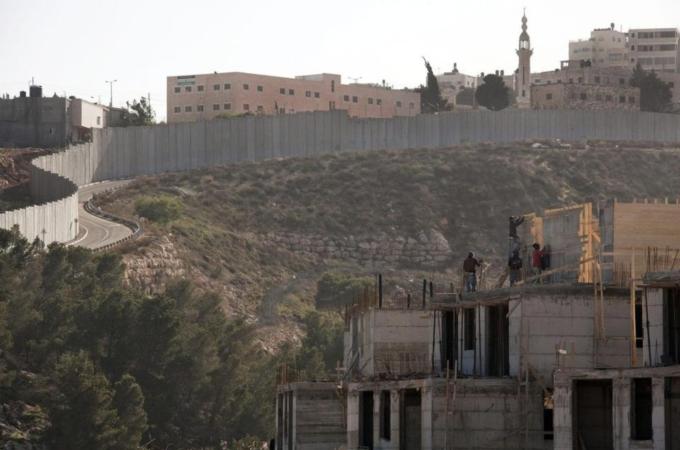
As time went by and new settlements were founded using more sophisticated means, the two essential functions of Wall and Tower – fortification and observation – held fast and repeated themselves on every scale. They dictated the location of the new settlements on the peaks of mountains and hilltops and the technological effort of the Israeli space program. They molded the entire landscape as a network of points, as an autonomous layer spread above the existing landscape, transforming the country by dividing it not according to natural, territorial and cadastral divisions, but according to dromological divisions, according to the speed of transportation and the lines of infrastructure. Thus we find in the Occupied Territories today two countries superimposed one on the other: on top, ‘Judea and Samaria,’ the land of settlements and military outposts, bypass roads and tunnels; and underneath, ‘Palestine,’ the land of villages and towns, dirt roads and paths. Ultimately, the essence of Wall and Tower had a decisive influence on the way Israelis perceive the space in which they live, which in turn maps out the values themselves: the observers versus the observed, a Cartesian ghetto versus a chaotic periphery, a threatened culture versus ‘desert makers’ (in the words of Ben-Gurion), city versus periphery, future and past versus present, Jews versus Arabs.

The cross between hasty settlement through military or para-military means in civilian camouflage, seclusion of ideologically homogenous community behind fortifications and panoptical observation on the surroundings has repeated itself countless times since the days of Wall and Tower. The ‘settlement point’ system has been implemented in national master plans throughout Israel’s history, such as the plan drawn up in the seventies for Judaization of the Galilee, and the current “spontaneous” expansion of settlements in the Occupied Territories. In all these cases, a large degree of ideological and social homogeneity was retained – whether through an existing core of founders, or through mechanisms that filter new residents according to social or economic criteria. Whatever the reasons for this homogeneity – security, ideology, or economy – the repetition of this settlement pattern, in which there is a distinct congruence between geographic area and social status, ideology or ethnic identity, has been one of the most prominent characteristics of the built Israeli landscape.

The Wall

Although it never had recognized borders, the State of Israel never seized to search for them in order to define itself geographically and socially. The history of Isarel is paved by a huge number of plans detailing possible borderline scenarios. The map of the State of Israel bares different representations of this quest: the pre-1948 “historical” international borderline, the 1949 temporary borderline, armistice green line, the 1967 cease-fire purple line, the 1974 forces’ separation blue line, the 1996 Peace Borderline. The physical expressions of those borderlines could varie from the barbed wires of Jerusalem’s demarcation line, to the “Fatma gate” of the “Good Fence”[10], from the bunkers of the “Barlev line”[11] to the electronic “separation fence” that is today under construction in the West Bank. A similar desperate quest for borders, limits, contours and separations characterizes also all the other scales of Israeli landscape and built environment. If the phenomena of gated communities is a relatively new to most of the western countries, in Israel it is quite normal to find villages, town and cities surrounded with a physical borderline: walls, fences and barbed wired fences, not to mention the symbolical “Eruv” borderlines defining the limits of the “Shabat zone”.[12] This impulse is even seen in the architectural scales - in urban environments (Tel Aviv, for example) where almost every building is surrounded by a fence enclosing a yard which very often remains unused and neglected, and even in the Israeli middle class suburbia that unlike its American model, is characterized by the drastic separation of the private.
Much has been said and written about the link between external threats on the State of Israel, whether real or imagined, and the formation of social unity and national cohesion. In Wall and Tower, we are shown exactly how this link is established: the priorities of the Wall and Tower outposts stipulated that first the wall was to be built, then the observation point and only at the end, the houses themselves. In total contrast to its ambitions of expansion, the Wall served in fact to perpetuate the ghetto mentality and the impulse of enclosure. The seclusion within the wall separates the settlement from its new environment and defines the new community not only as those who choose to live ‘inside,’ but as those who are under potential threat from outside. Shlomo Gur himself admitted that one of the reasons that Tel-Amal searched for land on which to settle was in order to prevent the dismantling of the kibbutz. This same principle holds true on a global scale as well, since the State of Israel’s self-definition depends on the fact that it was established first and foremost as a shelter for Jews threatened with extermination by the Nazi regime. The organization of Israel’s land is also based on this principle, as the degree of communal unity is directly connected to the imminence and intensity of external threats.

The Point

As a strategy, Wall and Tower realized the impulse for expansion through territorial conquests by establishing new ‘settlement points,’ a term that in itself hints at the fact that the ‘point’ on the map was more important than the ‘settlement’ itself. The location of the settlement as part of a greater strategic plan was of greater importance than its actual existence, and the location was determined according to optimal vantage points.
In Wall and Tower, the settlement point on the map is indeed a point within a strategic network of points. The Wall and Tower network was spread out in such a way that every outpost had eye contact with another, enabling the Towers to transmit messages through Morse code using flashlights at night and mirrors during the day.
The settlement point was first and foremost an observation point: erecting the Tower was the whole point.

The Tower

The Tower was the spearhead of industrialization and modernity not only because of its logistical and technological characteristics, but also because it transformed the entire environment into an object under the scrutiny of industrial and instrumental observation. This vantage point had its own accompanying technologies such as the binoculars and the light projector, and was organized as a systematic project that had to be managed and manned. Beyond the military implications of this vantage point, in terms of Virilio’s ‘I see, therefore I kill,’[13] The constant panoptic observation policed by the vantage point of the ‘tower’[14] determined the overpowering relations between the Wall and Tower settlements and their surroundings even before the actual cultivation of the land and its economic exploitation through agriculture or development.

As an initiative whose intention was to organize the logistics of the gaze, Wall and Tower transformed, literally from one day to the next, the territory, which it occupied. Henri Lefebvre characterized the agrarian time and space as a heterogeneous combination of variables such as climate, fauna and flora, while claiming that the industrialized time and space tends towards homogeneity and unity.[15] Despite the fact that the landscapes where the Wall and Tower outposts were located have always been an agrarian frontier, this organized observation point was sufficient to transform the territory into a industrialized space. Only a few such panoptic observation points had the power to unify an entire agrarian region – to eradicate, through the strategic threat, the complex economic and cultural differences that distinguished between the Arab Bedouins, farmers and urban population in the thirties. The very instrumentalization of the territory through the gaze invested the landscape with scenarios and schemes, threats and dangers, infuses places and objects with tactical possibilities, and situates them within a strategy and unifies them into one ‘political’ space.[16] It transformed the landscape into a battlefield, a scene of conflicts, a frontier – in other words, into a city.

The Camp and the Domain

As an almost dimensionless point in space, Wall and Tower is more an optical instrument than a place - an all-seeing eye that cannot see itself. But nevertheless, with its Wall, its Tower and its four shacks, Wall and Tower is a rough draft of a place.

Regardless to its resemblance to the European medieval urban imagery, Wall and Tower sketches in the most concrete manner the very scheme of the Israeli place: the Camp and the Domain.

Used by all the settlement organs, the term the Camp and the Domain expresses the scheme of the Israeli place as a division of the settled territory between two main functions - lands to be settled upon physically, and lands to be exploited. This term has shaped the Israeli attitude towards territory: the military logic that resided at the basis of the territorial relationships between the Camp and the Domain can be only compared to the economical logic that created divisions between the Urban and the Rural elsewhere. The concrete translations of the Camp and the Domain concept on the ground, either in the form of a Kibbutz or in that of a Moshav, imposed architectural solutions where the Camp is perceived as a coherent unified entity surrounded by the vast unbuilt Domain cultivated collectively (in the Kibbutz) or separately (in the Moshav). But above all, this division, which was very characteristic to the rural settlements, is at the very basis of one of Israel’s biggest social injustice: unlike other Western countries, where the social structure is based either on the social tradition (Europe) or on the economic practice (USA), the Israeli class system was based on the distribution of the country’s most precious resource - land. In that sense, the settler may be placed on the summit of the social pyramid. If in the first days of the State of Israel his prestige was only political and symbolical, soon enough it could be translated to material forms. Even today, the question of the Domain - who owns it, and what to do with it – seems no less complex and problematic than the question of Israeli borders, and it is still a source of one of Israel’s biggest debates.

Camp

‘The camp is your home – guard it well’ – this slogan, posted in countless Israeli military bases, can be seen as the essence of this program. If the camp is our home, and if it must be guarded, the fate of the camp’s residents is to become prisoners of their own gaze.

The efforts of settlement involved a series of tasks, some of which were military and tactical, while others were civilian and strategic. This dualism was expressed in slogans such as ‘one hand on the plough, the other on the sword.’ Despite the military means often used, a civilian appearance has always been, and still is, one of the Zionist Enterprise’s most important strategic objectives. This is the reason why Wall and Tower and the later mechanisms of settlement left the status of the place and the residents themselves in doubt. In every type of politically motivated settlement enterprise in the country, whether or not backed by the institution, there exists a paradoxical mixture of a civilian and military operation: a military operation, camouflaged in civilian clothes, recruited civilians under the patronage of the army.

‘Civilianization’ is the transformation of the soldier into the pioneer – who is able, if need be, to change his clothes and transform back into a soldier at any time – and the transformation of the camp into a home is the description also assigned to the transformation of the para-military outpost into a permanent settlement. This is the reason why the apparent preservation of normality, of routine civilian life, has always had to be backed by military and tactical operations, which in the long run demand much higher funds than the act of settlement itself: in Israel, the mundane is a strategic weapon.

Image

In Homa Umigdal, the image is one of ‘work in progress,’ a permanent construction site, a production line. The hyperactivism of transformation and construction was in absolute contrast to the passivity of the land. The Land of Israel was a virgin land to be possessed. The land of Israel was perceived as a clean slate, a tabula rasa, as raw material awaiting the sculptor. This perception lived on in the State of Israel, which became a place of perpetual motion from the temporary to the permanent and back again, a place whose core essence was not its permanency but movement and change. If one day the ‘right of return’ is granted to the Palestinians, it is very doubtful whether the returning refugees will find their way home – that is, if it still exists. Contrary to the illusions of permanency with which we are usually provided by urban and pastoral landscapes, and contrary to the static impression left by historic settlement patterns, the new Israeli settlement pattern has always been perceived as a dynamic process, focused on its power to transform rather than on becoming a permanent reality. Modern Zionism was fused by the inspiration of the industrial and colonial initiatives of the nineteenth century. If compared with Herzl’s vision of ‘The Canal of the Seas’-– the construction of a man-made canal which was meant to replace and eventually close off the Suez Canal – Wall and Tower was a humble act of industrialization of the environment, the large-scale operations came later. The State of Israel initiated immense transformations in the geography of the country: seas were dried up, roads were laid down, a network of infrastructure was spread out, ports were dug, forests were planted, deserts were made to blossom, towns and cities were founded. In Israel, every view of the landscape is merely a single frame taken from one continuous documentary film. Every photograph is only a coincidental image in an endless saga. In the same way, every built object is perceived according to its circumstances; always as a single coordinate on the long path of construction or ruin.

Trojan Horses

Wall and Tower initiated an original tradition of local Trojan horses, machines of infiltration and other types of ambulatory, temporary, political and hyperactive objects: the tent in the outpost and the mobile home in the settlements. These banal objects are ostentatious not because of the way they look, but rather because of their outward display of their potential for mobility, expansion and transformation; because they threaten to transform the temporary into the daily, the daily into the permanent and the permanent into the eternal; because of the way they represent all these possibilities in the landscape in order to transform the land itself into an arena of struggle and power.

Spectacle

There is no doubt that the mere appearance of new settlements was a spectacular event, an act of creating something from nothing, a spectacle of light[17] – the nocturnal and daylight signaling, the trajectories of tracer bullets and the echoes of explosions. Shlomo Gur saw in his invention only a prosaic answer to the problems of the new settlement: in his interview with Ariela Azulay he claimed to be indifferent to the their visual effectiveness. The type of interpretation done here would be entirely alien not only to the axiomatic perception he had of his system, but also to his character as a ‘man of action.’ But from the other hand, it’s hard to ignore the simple fact that in many of the Wall and Tower settlements operations, Gur himself was accompanied by the photographer Zoltan Kluger and his team from “The Oriental Company of Photography”.[18] Kluger’s wages where paid by the “Keren Hayesod”.[19] In addition to that, the Wall and Tower settlements of Ein-Gev and Massada/Shaar Hagolan were the subject and the location of the first Hebrew Technicolor film ever shot in Israel, “Spring at Galilee”, by Efraim Lisch (13 minutes, 1939),[20] that was produced and financed by the KKL-JNF. In a similar manner, the KKL-JNF financed and promoted the first Hebrew Opera “Dan the Guard” that celebrated the first days of the Wall and Tower settlement of Hanita. The opera was based on Sh. Shalom’s play “Shootings at the kibbutz” (1936) and was adapted in 1939 by the composer Marc Lavry and the newly immigrant writer Max Brod (!). The opera was performed 33 evenings in Tel Aviv in 1945.

The Mold

However, as is usually the case in Israeli architecture, the actual object is much more powerful than any image or metaphor. The real spectacle of Wall and Tower did not stem from the way it looked but from what it was, from what it did. It was, first and foremost, a wall; beyond the fact that the wall was a program, and was destined to become an ‘ideology,’ it was a plain wooden mold of 20 centimeters filled with gravel. The wall was a premonition of things to come, because whoever is able to fill the mold with gravel will not hesitate to fill it with other materials. Beyond the fact that it was an ad-hoc protective wall, whose job it was to prevent infiltration of unwanted visitors and to provide protection from bullets, the wall was a technological presentation and a logistic tour de force: it was the promise, the non-explicit threat of the concrete.


Notes
[1] My Grandfather, the late Benjamin Plascow, was always proud to remind me that he had been the first wounded of the “Events” of April 1936. He was stabbed in his chest in Jaffa Road on his way back from his work in Jaffa port. A tin cigarette box (which is today one of my family’s dearest objects) saved him from a much more serious injury.
[2] In that respect, see Rafi Segal and Eyal Weizman’s essay “The Mountain”, where they describes the Zionist and Israeli settlement project as a continual move from the valley to the mountain.
[3] Shlomo Gur-Gerzovsky (1913-2000) was a founding member of Kibbutz Tel-Amal and became a sort of national ‘project manager’ following his success as the founder of Homa Umigdal. Before the establishment of the State, he was responsible for planning the defense constructions of many settlements including those of the Old City in Jerusalem. Following the establishment of Israel, he was charged with the country’s first Grands Projets: the Hebrew University, the National Library and the Knesset building in Jerusalem.
[4] Yohanan Ratner (1891-1965), a trained architect and a former Red Army officer, was the chief architect and strategic planner of the Hagana, the pre-state predecessor of the Israeli Defense Forces (IDF.) He later became a general in the IDF. As a member of the central command during the War of Independence, Ratner was the only general who received Ben-Gurion’s permission to retain his non-Hebrew family name. Later he served as Dean of the Faculty of Architecture in the Technion in Haifa. As a teacher and dean in the 1950s, Ratner was considered a reactionary and one of the more ardent opposers of modernist architecture.
[5] Keren Kayemeth LeIsrael (Jewish National Fund) was established in 1901 during the fifth Zionist Congress in Bazel, in order to purchase land in Palestine - Eretz-Israel for the Jewish people. This organization became the most important factor in the land system of the country and untill today: KKL-JNF is the main proprietor of lands in the State of Israel, and owns more than 90% of them. As an organ of the Zionist movement, KKL-JNF became one of the state’s most important instruments to make sure that lands in israel would remain under Jewish (and no “Israeli”) ownership.
[6] The account of settlements and the quotations come from a conversation between Shlomo Gur and Ariella Azoulay, the main points of which were exposed in Azoulay’s book: Ariella Azoulay, How does it look to you? Tel-Aviv: Babel, 2000, pp.27-35; 10 Years, a Tel-Amal booklet,1946, p.30; Yehezkel Frenkel, ‘How we arrived at Homa Umigdal’ in 40 years to Homa Umigdal, a Tel-Amal booklet, p.21; Shlomo Gur, the man behind Homa Umigdal (a monologue recorded by Zeev Aner in The days of Homa Umigdal, editor: Mordechai Naor, Idan Series, Yad Ben Zvi Press, Jerusalem 1986, pp. 47-50.
[7] Yehezkel Frenkel, ‘How we arrived at Homa Umigdal’ in 40 years to Homa Umigdal, a Tel-Amal booklet, p.21.
[8] David Ben Gurion, a speech in front the soldiers of the NAHAL soldiers, 13 November 1948. An army for defense and building in On Settlement – an anthology, 1915-1956 , p. 104 , Hakibbutz Hameuhad, Tel Aviv, 1986.
[9] Altneuland was published in 1902. In this futuristic novel, inspired by the tales of Jules Verne, Herzl follows the adventures of a young Jewish intellectual from Vienna, Dr. Friedrich Lowenberg, who meets a mysterious character by the name of Kingscourt. Lowenberg and his companion decide to dissociate themselves from the decadent European lifestyle, and settle on a deserted island in the Pacific Ocean. On their way, they pass through the Land of Israel and find it in a state similar to the one Herzl found during his historic visit to Palestine in 1898. After ten years on the island, Lowenberg and Kingscourt decide to resume their travels. They return to the Land of Israel and discover ‘Altneuland’ – the old-new land that had been built and settled according to Herzl’s program in his book The Jewish State. The first translation of Altneuland was edited by Nachum Sokolov and was published in 1904 under the biblical title Tel Aviv, borrowed from the Book of Ezekiel. This is what perhaps made Tel-Aviv, which was set up five years later in 1909, into the only city in the world to be named after a book.
[10] The “Good Fence” is the title that was given to the borderline between the State of Israel and the “security belt” of South Lebanon since the Litany operation in 1978 up to the IDF retreat in 2000.
[11] The defensive fortification line along the Suez canal, conceived in the late sixties by the IDF chief of staff, general Haim Barlev.
[12] The “Eruv” is a religiuous symbolical borderline made of a wired line that contours every village, town and city in Israel. The “Eruv” defines a unified zone in which one can carry personal things during the Shabat.
[13] In this connection, one cannot ignore the work of my teacher, Paul Virilio, especially his book Guerre et Cinema, Cahiers du Cinema – Editions de l’Etoile, Paris, 1984 (War and Cinema, London and New York: Verso, 1999).
[14] See Roland Barthes’ renowned text ‘The Eiffel Tower’ and Michel Foucault’s book Discipline and Punish for more on the way observation from a tower ‘intellectualizes’ a landscape. Ariella Azoulay links this birds-eye view to another project of Shlomo Gur: in 1937, Gur took a series of photographs of the roofs of Jerusalem’s Old City, in order to plan the defense of the Jewish Quarter. Azoulay, who gives a detailed description of these photographs in the introduction to her published conversations with Gur, interpreted them as a model of ‘the official eye of the State of Israel’ (Azoulay, How does it look to you? p.28.) The mythological slogan spontaneously invented by a tired IDF soldier a moment after conquering the Hermon Mountain in 1973, who called it ‘the eyes of the state,’ should also be noted in this context.
[15] Henri Lefebvre, ‘Espace et Politique’, in Henri Lefebvre, Le Droit a la Ville, editions Anthropos, 1968, p.207
[16] This is a concrete example of Lefebvre’s claim ‘a landscape that has undergone instrumentalization becomes a political landscape’ – Lefebvre, Espace et Politique, pp. 277,278.
[17] See Paul Virilio’s explanation of the link between the light projectors of anti-aircraft defense mechanisms during the Second World War and the emblem of 20th Century Fox, as well as other spectacular expressions such as Albert Speer’s Cathedral of Light in Nurnberg.
[18] For A detailed account on Kluger’s activity during the period of Wall and Tower, see: Oded Yedaaya Towards a Social Fuction: on Zoltan Kluger’s Photography in the period of Homa Umigdal, Kav 10, July 1990, pp. 13-19. According to Yedaaya, Kluger was born in Hungaria in 1895 and emmigrated to Germany in the Twenties, where he worked in the Berliner Illustriert Zeitung. In 1933 (or 1934) he emmigrated again to Palestine/Eretz Israel with another photograph Nahman Schiffrin and together they established “The Oriental Company of Photography”.
[19] The Keren Hayesod (The Foundation Fund), today known also as “Keren Hyesod – United Israel Apeal” is part of the Jewish Agency. Founded in the Zionist Congress in London on July 1920, The fund is one of Israel’s largest fund raising organization and is active all over the world except the USA.
[20] In order to really appreciate the effort of the KKL-JNF in producing Spring in Galilee, it is important to remember the technological competition that took place in the same period between the American Technicolor and the German Agfacolor. The first German color film Die Goldene Stadt by Veit Harlan (the director of The Jew Suss) was shown to the public only in 1943. Virilio, Guerre et Cinema, pp. 10-11. 


Notes on the essay
a) The origin, the insights, the writing and the research for this essay began in the mid 80's within the framework of a simple 2nd year project on vernacular architecture at the Ecole Specpiale d'Architecture (Paris). 
since 2002, The essay has been published in numerous books and publications in English, French and Hebrew.
It appeared in English for the first time in 2002 in "A Civilian Occupation" a catalogue edited by Rafi Segal and Eyal Weizman for the Israeli presentation at the UIA congress in Berlin. Shortly before the distribution, the catalogue was censored by the Israeli Association of Architects and the 7000 printed copies of the catalogue were scrapped. (For a review of the catalogue and the coverage of this "affair", see Alan Riding's NY Times article from August 2002 "Are Politics Built into Architecture?") The catalogue was republished a year later, in 2003, with two new prefaces by Paul Virilio and me under a form of a small book by Babel (Tel Aviv) and Verso (London), in French by Babel and Les Editions de L'Imprimeur (Paris), in the catalogue of the exhibition "Territories" curated by Eyal Weizman and Anselm Franke at the KunstWerke art institut of Berlin, and in the book "Cities of Collision" edited by Philipp Misselwitz and Tim Rienietz and published by Birkahauser in 2006. The Hebrew version of the essay appeared in "Sedek" Magazine #2 in 2008.
b) All the photos were taken by Zoltan Kluger between 1936 and 1939


Wednesday
Aug012012

Israel wall used for segregation, not just security

http://www.aljazeera.com/indepth/opinion/2012/07/201273091647695790.html

By Ben White     Al Jazeera       31 July 2012

Israel's separation wall is unjustly disassociating Palestinian neighbourhoods from the city of Jerusalem.


In East Jerusalem, the separation wall forces many Palestinians to pass through checkpoints every day [EPA]

It was recently revealed that a senior official in the Jerusalem municipality has asked the Israeli military "to take responsibility for handling civilian matters pertaining to Jerusalem residents east of the separation fence".

Jerusalem municipality's director-general Yossi Heiman told the meeting a few weeks ago that the city "wants the IDF [Israeli Defence Forces] to take responsibility for monitoring construction and providing sanitation services".

Ha'aretz reported that "the meeting concluded with a decision to form a committee that will present a plan to the government".

Tens of thousands of East Jerusalem residents with blue Israeli identity cards living in Palestinian neighbourhoods beyond the Separation Wall are "cut off from the bulk of the city" and forced "to pass through checkpoints on a daily basis in order to get to work, attend school, obtain medical services, visit family, etc". This "physical separation", in the words of the UN's OCHA, means "residents suffer from impeded access to services on the 'Jerusalem' side of the Barrier, the lack of municipal services in situ, a security vacuum and increasing lawlessness and crime".

Behind a new checkpoint, and hemmed in by the Wall and Israel's colonies, Shuafat refugee camp typifies the bitter irony behind Jerusalem Mayor Nir Barkat's hollow claim to oversee a "united" city. Household waste gathers in piles, construction is unregulated, and crime is unchecked.

As local doctor Salim Anati told me during one of my visits to the camp in 2010, Shuafat camp is "a problem" for the Israeli plan of making "a continuity of settlements on the east side of Jerusalem" - thus the camp is "on the wrong side" of the Wall. He predicted that "in a few years, Israel can turn around and say that those on the other side of the Wall are no longer part of the city".

That same year, Jerusalem city councillor Yakir Segev made a speech in which he said that the Palestinian areas east of the Wall were "no longer part of the city", noting that the "separation fence… was built for political and demographic reasons - not just security concerns". In December 2011, Mayor Barkat publicly proposed "relinquish[ing] areas of the municipality that are located outside of the fence", adjustments that, "according to a municipal source", would mean "a very small territorial gain for Jerusalem, with a loss of approximately 40,000 Arab residents".

It is a familiar story. Speaking to BBC's Hardtalk in July 2011, Mayor Barkat confirmed that he wants to maintain a Jewish majority in the city. A 2010 US diplomatic cable records Barkat's belief that the natural growth of Jerusalem's Palestinians is a "strategic threat" (comments that the cable notes "reflect long-standing GOI [Government of Israel] policy regarding the desired demographic balance in Jerusalem"). A previous mayor of Jerusalem, Ehud Olmert, said while in office that it is "a matter of concern when non-Jewish population rises a lot faster than Jewish population".

The desire to be rid of Palestinian neighbourhoods east of the Wall thus shatter two persistent myths. The first is that the route of the Wall was designed for "security", rather than as an element in a regime of colonial segregation. The second myth is that Jerusalem - where, in the words of Deputy Mayor Meron Benvenisti, "an ethnic population ratioserves as a philosophy" - is a city whose residents enjoy equality. In other words, the myth and reality is a microcosm of Israel as a whole, where the motto continues to be "maximum land with minimum Palestinians, maximum Palestinians on minimum land".

Ben White is a freelance journalist, writer and activist, specialising in Palestine/Israel. He is a graduate of Cambridge University.

The views expressed in this article are the author's own and do not necessarily reflect Al Jazeera's editorial policy.