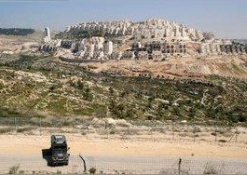
This report, covering the 6 month period following the Annapolis Conference, is also available at the following link: http://www.nad-plo.org/news-updates/Post-Annapolis%20Settlement%20Activity%20(27%20Nov%202007%20-%2025%20May%202008).pdf
For further updates please check our homepage: http://www.nad-plo.org/
Communications Department
Negotiations Support Unit - Report
PLO Negotiations Affairs Department
Israeli Settlement Activity Since Annapolis
27 November 2007 - 25 May 2008
At the Annapolis Conference, convened on 27 November 2007, Israel and the Palestinians renewed their respective commitments under the Road Map. Chief among Israel’s obligations are “[freezing] all settlement activity (including natural growth of settlements)” and “immediately [dismantling] settlement outposts erected since March 2001”. Following is a summary of Israeli settlement activity during the first six months after Annapolis, covering the period from 27 November 2007 to 25 May 2008.
Far from being “frozen,” Israeli settlement activity continued unabated throughout the West Bank, particularly in and around East Jerusalem, during the first six months after Annapolis. Indeed, Israeli settlement activity in virtually all areas—from planning to authorization to construction—increased substantially during the reporting period, as summarized below.
A. Official Policy Statements
Since Annapolis, Prime Minister Ehud Olmert and other senior Israeli officials have repeatedly made clear that Israel would not implement a genuine settlement freeze. Among other things, Olmert has said that Israel would continue building in settlements in and around East Jerusalem as well as in the so-called settlement ‘blocs’, thus effectively negating the very purpose of the freeze. Moreover, despite clarification by U.S. Secretary of State Condoleezza Rice that “the United States doesn’t make a distinction” between settlement activity in East Jerusalem and the rest of the West Bank, Israeli officials continue to make unilateral exemptions to their settlement freeze obligations. For example:
· On March 31, Olmert promised Shas party spiritual leader Rabbi Ovadiah Yosef that he would authorize construction on “Jerusalem envelope” lands which had thus far been frozen. According to Shas party officials, “[t]he Prime Minister promised Rabbi [Yosef] unequivocally that the construction in all the Jerusalem envelope communities will not be hindered and will be unfrozen without delay.” (Ha’aretz)
· On February 25, Israeli Deputy Premier Haim Ramon informed members of the Knesset’s State Control Committee that the current “freeze” imposed on some West Bank settlements, already partial in nature, would be relaxed even further. Under the new policy, settlement construction in areas deemed not to have “political significance” would no longer require formal approval by the political echelon (i.e., the Prime Minister and/or Minister of Defense).[1] <#_ftn1> The new policy is based on a proposal put forth by the Ministry of Justice in December, at which time Talia Sason, a former state attorney previously charged with investigating settlement activity, observed: “The proposal, if accepted, would constitute a clear and unequivocal violation of [the] commitment of Israel’s Prime Minister to the President of the United States regarding the illegal outposts in the West Bank and expansion of existing settlements.”[2] <#_ftn2>
· During a February 25 hearing of the Knesset’s State Control Committee, Assistant Minister of Defense for Settlement Matters Eitan Broshi declared that there was no policy of “drying” the settlements. To prove his point that there was in effect no freeze, Broshi cited the recent approval of several settlement construction projects to be implemented in the coming months, adding that, “[p]riority is being given to Jerusalem, Gush Etzion and the settlements located in the settlement blocs.”[3] <#_ftn3>
B. Land Confiscation
Israel continued to confiscate Palestinian land for settlement purposes, most notably with regard to the Wall and other settlement infrastructure:
On February 23, Israeli military authorities issued a military order (#T/183/5) for the confiscation of 766 dunums (~192 acres) of Palestinian land belonging to Adh-Dhahiriya, Dura and Ramadin villages, in the southern Hebron governorate. The military order is for construction of the Wall around the Eshkolot settlement. Once complete, the wall around Eshkolot (pop. 225) will effectively seize an additional 2,400 dunums that will become inaccessible to Palestinians. (Ma’an, OCHA, ARIJ)
On April 16, Israeli military authorities issued an order (#T/06/08) for the confiscation of 18.9 dunums (~4.7 acres) of Palestinian land belonging to Na’lin village in the western Ramallah governorate for the construction of a new checkpoint terminal (“Qiryat Sefer”) and a segment of the Wall near Modi’in ‘Illit settlement.
C. Settlement Authorization & Planning
1. Settlement Plans
· In the first six months after Annapolis (December-May), Defense Minister Ehud Barak approved the construction of at least 946 housing units in several West Bank settlements, including Ariel, Avenat, Betar ‘Illit, Elqana, Efrata, Giv’at Ze’ev, Ma’ale Adumim, Modi’in ‘Illit, Talmon, Negohot and Sha’are Tiqva.[4] <#_ftn4>
· Israeli authorities have also announced plans for several additional settlement construction projects in various West Bank settlements, including:
o The Israeli Civil Administration published a notification in the February 25 edition of Ha’aretz regarding a plan to add 94 new housing units in Modi'in ‘Illit settlement (Plan No. 210/4/2) in the western Ramallah governorate.
o On March 9, Prime Minister Olmert approved the resumption of construction of 750 housing units in Giv’at Zeev settlement. The plan, which was initially approved in 1999 but suspended two years later, calls for building 200 units initially and another 550 in the future. (Reuters, Ha’aretz)
o Ha’aretz reported on March 25 that Israeli Defense Minister Barak was set to approve the construction of 80 housing units in El’azar settlement, southwest of Bethlehem city. The new expansion will connect the settlement with Derekh Ha‘Avot, an outpost established in 2001 on privately owned Palestinian land and which currently contains 10 permanent structures and numerous caravans.
o On April 2, Yediot Ahranot reported on a plan recently presented by the Israeli Ministry of Construction and Housing to the Prime Minister to build 1,900 new settlement housing units in 2008. According to the plans, which were developed in coordination with the Prime Minister's Office, 158 apartment units will be built in Efrata, 682 in Betar ’Illit, 160 in Geva’ Binyamin, 510 in Giv’at Ze'ev, 302 in Ma’ale Adumim, 48 in Qiryat Arba’, and 48 in Ariel for settlers evacuated from Gaza in 2005.
· Another 9,617 housing units in and around East Jerusalem have been advanced since Annapolis, of which 5,247 units were submitted for public review, including in the settlements of East Talpiot, Givat HaMatos, Gilo, Har Homa, Neve Ya’aqov and Ramot,[5] <#_ftn5> some of which are summarized below:
o On February 20, the Israeli-defined municipality of Jerusalem’s Department of Planning and Construction published an official notification for a plan to construct 393 new units in Neve Ya’acov settlement, north of East Jerusalem.
o In late March, the Jerusalem District Commission for Planning and Construction deposited for public review a plan to build 813 housing units in Giv’at HaMatos settlement on 425 dunums (~106 acres) of land in Beit Safafa, southwest of East Jerusalem. The announcement, which was open for objections until May 21, is part of a larger plan to build some 3,700 housing units in Giv’at HaMatos. The plan’s first phase, which envisions 2,337 housing units on 411 dunums (~103 acres) was deposited for public review in January. (Al Quds)
o On March 31, the local planning committee of the Israeli-defined Jerusalem municipality authorized a plan to build 600 housing units in Pisgat Ze’ev settlement, northeast of East Jerusalem. (Jerusalem Post, Ynet news)
o On May 14, Ha’aretz reported that the Israeli-defined Jerusalem municipality has begun the process of approving a plan for a new settlement complex, including a synagogue, in the heart of the Palestinian neighborhood of Silwan south of the Old City. The plan, submitted by the right-wing Elad association, includes 10 apartments, kindergarten classrooms, a library and underground parking for 100 cars.
o On May 21, Israeli Housing Minister Zeev Boim instructed his ministry to invite tenders for the construction of 286 units in Betar ‘Illit settlement in western Bethlehem. The tenders are part of a plan approved by Prime Minister Olmert in late March to build 800 new units in Betar ‘Illit. (Ha’aretz)
2. Tenders
In the six months since Annapolis, Israeli authorities issued five tenders for settlement construction, totalling at least 847 new housing units (see table below), as compared with just 138 housing units tendered in the 12 months prior to Annapolis.
Settlement Governorate Date of Tender Status # Housing Units
Har Homa Bethlehem 2 Dec. 2007 contracted 307
East Talpiot Jerusalem 23 Dec. 2007 contracted 440
Gilo Jerusalem 31 Dec. 2007 contracted n/a (hotels)
Ariel Salfit 28 Apr. 2008 open (11 June) 48
Elkana Salfit 28 Apr. 2008 open (11 June) 52
Total 847
3. Building Permits
According to Israel’s Central Bureau of Statistics, in the first three months after Annapolis (Dec.-Feb.), Israel’s Ministry of Construction and Housing issued building permits for at least 327 housing units in West Bank settlements, not including settlements in and around East Jerusalem. Of these, 176 permits were issued in January alone, which is nearly as many as the previous four months (Sep.-Dec.) combined (see table below).[6] <#_ftn6>
Pre-Annapolis Post-Annapolis
Sep. 07 Oct. 07 Nov. 07 Dec. 07 Jan. 08 Feb. 08
37 33 44 67 176 84
D. Settlement Construction
Settlement construction projects, including both housing and infrastructure, continued apace throughout the West Bank, particularly in and around East Jerusalem.
1. Housing Units
· The Israeli Ministry of Construction and Housing’s website currently identifies construction projects in at least nine “urban” settlements in the West Bank (including East Jerusalem), totalling 4,878 settlement housing units.[7] ftn7 Some 91 percent of these are in the Metropolitan Jerusalem area, with 42 percent in Har Homa alone. Following is a breakdown of current settlement construction projects:
Settlement Governorate Housing Units Sold
Alfe Menashe Qalqilya 256 112
Efrata Bethlehem 102 42
Ariel Salfit 130 56
Betar ‘Illit Bethlehem 628 376
Geva’ Binyam Jerusalem 180 104
Giv’at Ze’ev Jerusalem 546 7
Har Homa Jerusalem 2,062 1,059
Ma’ale Adumim Jerusalem 944 286
Qarne Shomron Salfit 30 --
Totals 4,878 2,042
According to data from the Israeli Ministry of Construction and Housing, the Israeli government began construction on at least 294 new housing units in West Bank settlements in the first three months after the Annapolis Conference, as indicated in the table below (Note: Figures do not include settlements in and around East Jerusalem or private construction):
Housing Starts / Completions[8] <#_ftn8> Dec. 07 Jan. 08 Feb. 08 Total
Started (Public) 54 136 104 294
Completed (Public) 32 56 10 98
Construction was also ongoing in several smaller settlements,
including:
o On January 15, construction began on 66 housing units in the Ma’aleh HaZeytim settlement in East Jerusalem’s Ras al-Amud area. (Ha’aretz)
o In the settlement of Eli, southeast of Salfit, a new neighborhood comprising 27 trailers has been under construction since mid-January. (Peace Now)
o In February, six new pre-fabricated homes were erected in Kochav HaShahar settlement, northwest of Jericho. (Peace Now)
o New construction was taking place in Maskiot settlement, in the Tubas governorate, to accommodate 10 settler families evacuated from Gaza in 2005. (Ha’aretz)
o Some 100 of the 400 units planned in the Nof Zahav settlement, located in Jabal Mukabber near East Jerusalem, are nearly complete and ready for occupancy. (Peace Now)
2. Roads & Infrastructure
· On December 27, a plan for the final stage of the Jerusalem Ring Road, was officially deposited for public review. Most sections of the massive settler road, which will completely encircle East Jerusalem in order to link up the main Jerusalem-area Israeli settlements with West Jerusalem, are now complete, with the exception of a 11.5 km-long stretch of the eastern ring road (running southward from Az-Za‘im to Sur Bahir and westward along the southern edge of Har Homa and Giv’at HaMatos settlements). In order to complete this project, Israel intends to confiscate more than 1,237 dunums (309 acres) of privately owned Palestinian land and demolish several houses.
· Work is ongoing on the first phase of the Jerusalem Light Rail, which is aimed at linking the settlements of Pisgat Ze’ev, Neve Ya’kov and French Hill with West Jerusalem. Construction on the project, which began in 2003, is currently concentrated in the Shu’fat and Shaykh Jarrah areas.
· Excavation work is also continuing on several tunnels adjacent to the Al-Aqsa Mosque Compound (Haram al-Sharif) in the Old City of Jerusalem, in order to facilitate settler movement in the area, including:
o a 100 m tunnel in the Hamam Al-‘Ain area of the Old City’s Muslim Quarter;
o the existing Western Wall tunnel underneath the Haram compound; and
o a new 600 m tunnel being excavated in the Silwan area under ‘Ain Silwan Mosque and private Palestinian houses by the El’ad Foundation and under the supervision of the Israeli Antiquities Authority, to connect Israeli settlers in Silwan with the Haram compound.
· Road and infrastructure preparation also continued in the E-1 expansion area between East Jerusalem and Ma’aleh Adumim settlement, particularly in relation to the newly constructed police headquarters in the eastern part of E-1, which was officially inaugurated on May 19.
· Construction also continued on several settler by-pass roads, as well as “alternate” roads and tunnels for Palestinians, as part of Israel’s plan to create segregated road networks in the West Bank for Israeli settlers and Palestinians, including on:
o a new road to run parallel with Road 465, which now serves Israeli settlers and is to become part of the Wall around Beit Arye and Ofarim settlements, between Rantis and Shuqba villages in the Ramallah governorate. (OCHA)
o a new road between Beit Ur al Fauqa and Tira villages in the Ramallah governorate, as well as an underpass to run beneath Road 443, on which Palestinian pedestrian and vehicular traffic is currently prohibited. The “alternate” road/tunnel would be one of only three points of entry/exit serving the 45,000 Palestinians completely encircled by the Wall and Road 443. (OCHA)
o a new road between Beit ‘Ur al Fauqa and Beituniya villages. A total of 588 dunums (~147 acres) of land were confiscated, and some land levelling at Beit ‘Ur al Fauqa had begun. (OCHA)
o a new “alternate” road between ‘Anata and Az Za’ayim villages (Road 70), which was in the final construction stage, to allow Palestinians to enter and exit Az Za’ayim instead of allowing them to use the entrance lane off Road 1 near Za’ayim checkpoint. (OCHA)
· As of April 29, Israel had established 607 checkpoints, roadblocks and other obstacles to movement throughout the West Bank, as compared with 561 at Annapolis. This represents an 8 per cent increase. (OCHA)
3. The Wall
Despite reports suggesting that Wall construction has been suspended due to budgetary constraints, work on the Wall and supporting infrastructure continued in several places, including:
· a patrol road along the eastern side of Road #60 to the south of Tunnel checkpoint terminal, in the Bethlehem governorate (OCHA);
· land levelling and installation of new buildings at An Nu’man checkpoint terminal (OCHA); and
· new checkpoint terminals at Beit Yatir and Tarqumiya in the Hebron governorate, and Al-Jab’a checkpoint in the Bethlehem governorate. (OCHA)
E. Financing & Incentives
On December 23, Israeli officials confirmed that the Israeli government has allocated nearly NIS 100 million (US $27 million) in its 2008 budget for infrastructure work and the construction of 750 housing units in the Jerusalem-area settlements of Har Homa and Ma’aleh Adumim.
· On January 14, the Knesset Finance Committee approved a request by treasury officials for an additional NIS 15 million (US$ 4.6 million) to fund private security services for 2,000 Israeli settlers in the Abu Dis area of East Jerusalem, which already receive NIS 38 million (US$ 11.7 million) from the Ministry of Housing. [9] ftn9
F. Settlement Outposts
Of the approximately 110 settlement outposts in the West Bank, 58 of which were established since March 2001, only three were dismantled since Annapolis. Moreover, Israel continues to speak of removing only “unauthorized” outposts (i.e., those established in violation of domestic Israeli law), having identified only 26 such outposts, although the Road Map contains no such distinction.
· In April, Israeli military forces evacuated the outposts of ‘Harhivi’ and ‘Shvut Ami’ in the northern West Bank, as well as the Mevo Horon-Tzafon outpost in the Ramallah governorate. The evacuations are reportedly part of an agreement reached between the Israeli Ministry of Defense and settler leaders to dismantle some of the 26 designated outposts and relocate the settlers to the large settlement “blocs” or to settlements near Jerusalem, in addition to government assurances to approve building permits and other expansion plans in the more established settlements.
· In the meantime, outposts continued to be established and expanded, including:
o A new winery currently being set up some 3 km from Migron outpost, which the Israeli government promised the Israeli Supreme Court would be removed by August. (Ha’aretz)
o A new outpost established in May in the southwest Hebron governorate between Negohot settlement and Mitzpe Lachish outpost. (Peace Now; Ynetnews)
Foot Notes:
[1] ftn ref1 - Yedi‘ot Aharanot, 26 February 2008.
[2] ftn ref2 - Quoted in Washington Times, 7 December 2007.
[3] ftn ref3 - Peace Now, Report of the State Control Committee Hearing – 25/2/08. Available at: http://www.peacenow.org.il/site/en/peace.asp?pi=549&fld=554&docid=3165 <http://www.peacenow.org.il/site/en/peace.asp?pi=549&fld=554&docid=3165> <http://www.peacenow.org.il/site/en/peace.asp?pi=549&fld=554&docid=3165> (accessed on 29 February 2008).
[4] ftn ref4 - Peace Now, “The Death of the Settlement Freeze - 4 Months Since Annapolis,” March 2008.
[5] ftn ref5 Ir Amim Monitoring Report, “Negotiations toward an Accord on Jerusalem: Declarations vs. Actions,” Apr 2008.
[6] ftn ref6 - Israeli Central Bureau of Statistics, “Construction Area, Buildings and Dwellings Approved in Private Construction, By Month of Permit Approval,” (Table O/8). Available at: http://www1.cbs.gov.il/www/yarhon/o8_e.htm (accessed 25 May 2008).
[7] ftn ref7 - Available figures are only for “urban” construction (i.e., settlement municipal and local councils, but not regional councils). Available at: http://www.moch.gov.il/Moch/ProyekteyBniya.htm <http://www.moch.gov.il/Moch/ProyekteyBniya.htm> (accessed on 25 May 2008).
[8] ftn ref8 - Israeli Ministry of Construction and Housing, “Housing Starts Initiated by Ministry of Construction and Housing, By District - Urban and Rural Areas,” (Table A.7(A)); “Housing Completions Initiated by Ministry of Construction and Housing, By District - Urban and Rural Areas,” (Table A.8(A)). Available at: http://www.moch.gov.il/MOCH/MonthlyBulletin/boards.htm (accessed 25 May 2008).
[9] ftn ref9 - Ir Amim Monitoring Report, April 2008.
 Wednesday, November 5, 2008 at 11:56PM