NEWS
About Us

Architects and Planners for Justice in Palestine
UK architects, planners and other construction industry professionals campaigning for a just peace in Israel/Palestine.

DATABASE & REPORTS
Friday
Sep112009

Dismantling the Matrix of Control  

Jeff Halper

September 11, 2009

http://www.merip.org/mero/mero091109.html

(Jeff Halper is director of the Israeli Committee Against House Demolitions. He can be reached at jeff@icahd.org.)

Jeff Halper’s original article on the “matrix of control” appeared in Middle East Report 216 (Fall 2000).

For additional background, see Gary Sussman, “The Challenge to the Two-State Solution,” Middle East Report 231 (Summer 2004).

Almost a decade ago I wrote an article describing Israel’s “matrix of control” over the Occupied Palestinian Territories. It consisted then of three interlocking systems: military administration of much of the West Bank and incessant army and air force intrusions elsewhere; a skein of “facts on the ground,” notably settlements in the West Bank, Gaza and East Jerusalem, but also bypass roads connecting the settlements to Israel proper; and administrative measures like house demolitions and deportations. I argued in 2000 that unless this matrix was dismantled, the occupation would not be ended and a two-state solution could not be achieved. 

Since then the occupation has grown immeasurably stronger and more entrenched. The first decade of the twenty-first century has so far seen the steady constricting and fragmentation of Palestinian territory through still more wholesale expropriation of Palestinian land, checkpoints and other physical restrictions on freedom of movement, settlement construction, more and more massive highways intended for Israeli settlers, control over natural resources and, most visibly of all, the erection of the separation barrier in the West Bank and East Jerusalem. Since December 2000, according to the Israeli human rights organization B’tselem, the settler population of the West Bank has grown by 86,000 and that of East Jerusalem by 50,000. Gaza was evacuated of settlers and soldiers in 2005, but Israel retains near complete control over egress and exit of people and goods to and from the coastal strip, regularly cuts supplies of fuel and other necessities to punish the residents and mounts military incursions at will. All the Palestinian territories are subject, to one degree or another, to the measures of house demolitions, “closures” that halt economic activity, administrative restrictions on movement, deportation, induced out-migration and much more.

Indeed, the matrix has reconfigured the country to such an extent that today it seems impossible to detach a truly sovereign and viable Palestinian state from an Israel that has expanded all the way to the Jordan River. Anyone familiar with Israel’s “facts on the ground,” perhaps first and foremost the settlers, would reach the conclusion that, in fact, the matrix cannot be taken apart in a piecemeal fashion, leaving a few settlements here, a road there and an Israel “greater” Jerusalem in the middle. The matrix has become far too intricate. Dismantling it piece by piece, with Israel stalling by arguing for the security function of each “fact on the ground,” would be a frustrating series of confrontations that would eventually exhaust itself. The only way to a genuine two-state solution and not a cosmetic form of apartheid is to cut the Gordian knot. The international community, led by the United States, must tell Israel that the occupation must be ended entirely. Israel must leave every inch of the Occupied Territories. Period.

And now, at this critical juncture, as the two-state solution for the Israeli-Palestinian impasse disappears under the weight of Israeli settlements, there is a great imponderable: Is President Barack Obama genuinely serious about reaching such a solution or is he merely going through the motions familiar from previous administrations? 

The Tea Leaves

Many Palestinian, Israeli and international proponents of a just peace took heart in Obama’s early gestures. Beginning with the appointment of former Sen. George Mitchell as special envoy and continuing through the president’s June 4 speech in Cairo, these proponents allowed themselves, after years of disappointment and struggle, a cautious hopefulness. Some of the speech’s formulations, like the nods to the “pain of dislocation” felt by Palestinians and the “daily humiliations” of occupation, had been heard before. But one sentence had not been: Obama said that a two-state solution “is in Israel’s interest, Palestine’s interest, America’s interest and the world’s interest.” Obama seemed to “get it,” that is, he seemed to understand that the US is isolated politically by its unquestioning backing of Israel, which is seen as obstructing a solution to the conflict. And, for the first time, a US president actually said that resolving the Israeli-Palestinian conflict is in the vital national interest, not just a nice thing to do. These words significantly raise the bar. Framing the conflict in this way makes it easier for the administration to win Congressional support for tougher demands upon Israel while undermining the ability of the American Israel Public Affairs Committee (AIPAC) to mount an effective resistance, given American Jewish sensibilities about suspicions of dual loyalty.

Since the Cairo speech, however, fundamental doubts about US efforts have resurfaced. The only demand made by Obama upon Israel has been for a settlement “freeze,” a welcome symbolic gesture, to be sure, yet irrelevant to any peace process. Israel has enough settlement-cities in strategic “blocs” that it could in fact freeze all construction without compromising its control over the West Bank and “greater” Jerusalem, the Arab areas to the north, south and east of the city where Israel has planted its flag. Focusing on this one issue -- which, months later, is still being haggled over -- has provided Israel with a smokescreen behind which it can actively and freely pursue more significant and urgent construction that, when completed, will truly render the occupation irreversible. It is rushing to complete the separation barrier, which is already being presented as the new border, replacing the “Green Line,” the pre-June 1967 boundary to which Israel is supposed to withdraw, by the terms of UN Security Council resolutions, but on which even the most ardent two-staters have long since given up. Israel is demolishing homes, expelling Palestinian residents and permitting Jewish settlement throughout East Jerusalem, measurably advancing the “judaization” of the city. It is confiscating vast tracts of land in the West Bank and “greater” Jerusalem and pouring bypass road asphalt at a feverish pace so as to permanently redraw the map. It is laying track on Palestinian land for a light-rail line connecting the West Bank settlement-city of Pisgat Ze’ev to Israel. It is drying up the main agricultural areas of the West Bank, forcing thousands of people off their lands, while instituting visa restrictions that either keep visiting Palestinians and internationals out of the country altogether, or limit their movement to the truncated Palestinian enclaves of the West Bank.

“Quiet,” behind-the-scenes diplomacy is surely taking place, but the few details that have emerged are far from reassuring. The State Department has mocked as “fiction” a ten-point document given to the Arab press by Fatah figure Hasan Khreisheh that promises an “international presence” in parts of the West Bank and US backing for a Palestinian state by 2011. The component of this alleged plan that seems more likely is that the US wants a partial freeze on settlement activity from Israel in exchange for a pledge from Washington to push for more stringent sanctions upon Iran for its nuclear research. On August 25, the Guardian quoted “an official close to the negotiations” saying: “The message is: Iran is an existential threat to Israel; settlements are not.” By all indications, if the Obama administration does present a regional peace plan, which it is expected by many to do around the time of the UN General Assembly meeting on September 20, it will be nothing more than a “rough draft.” It is no exaggeration to say a two-state solution will rise or fall on the outlines of this draft -- and may perhaps fall forever if no concrete plan is presented at all, which is also possible. Although the two-state solution has been eulogized many times in the past, Obama represents a best-case scenario. If he presents, in the end, a disappointing peace plan that offers no genuine breakthrough, then the shift to a one-state solution on the part of the Palestinian people and their international supporters will be inescapable.

Sovereignty and Viability 

So how can Obama’s plan be judged if and when it is unveiled? Its chance of success can be predicted by how well it addresses the fundamental needs, grievances and aspirations of the peoples involved. An effective approach to ending the conflict, as opposed to shopworn posturing, rests on at least six elements: national expression for both peoples; economic viability for Palestine; a genuine addressing of the refugee issue; a regional approach; security guarantees; and conformity with human rights norms, international law and UN resolutions.

Israeli Jews and Palestinian Arabs are not simply ethnic groups, like, for example, American Jews or Arab-Americans. They are two peoples who, like national groups everywhere, demand self-determination. This reality actually lends credence to a two-state solution, but only if the Palestinian state is truly sovereign and economically viable. One should not forget that, in the days of apartheid, South Africa established ten “bantustans,” small and impoverished “homelands” on 11 percent of South African land, seemingly to address the demand of the black population for self-determination but actually to ensure a “democracy” for the white population on 89 percent of the country. Israeli Prime Minister Benjamin Netanyahu’s notion that the Palestinians should get “autonomy with certain characteristics of a state” on about 15 percent of historic Palestine -- “autonomy plus-independence minus,” as he called it -- is reminiscent of apartheid. 

If the Obama administration’s plan does not cut the Gordian knot that is Israel’s matrix of control -- something no plan or initiative has yet succeeded in doing -- it will simply fail to achieve an equitable two-state solution. Only a complete withdrawal of Israel from all the Occupied Territories and the sharing of Jerusalem with no restrictions on movement can avert a Palestinian bantustan. 

Obama’s plan, like its predecessors, seems destined to leave the major Israeli settlement blocs intact, including those in Palestinian East and “greater” Jerusalem. Even with so-called territorial “swaps,” this measure would significantly compromise the sovereignty and economic viability of a Palestinian state. The area designated on Israeli maps for future expansion of the Ma’ale Adumim settlement reaches to the outskirts of Jericho in the Jordan Valley, while the Ariel bloc already extends between the northern West Bank town of Nablus and points south. Taken together, settlements and the highways that interlink them displace Palestinian passenger and commercial vehicles onto a few narrow routes, while the checkpoints intended to protect the settlers snarl traffic on a predictably unpredictable schedule. And then there is the towering wall. It is not a landscape made for easy economic integration.

Why, then, leave these massive settlements intact? The argument is that their residents would object to the point of a civil war in Israel. This is patent nonsense. True, these settlement blocs contain 85 percent of Israelis living in the Occupied Territories, but these are not the ideological settlers who claim the entire Land of Israel from the Mediterranean Sea to the Jordan River. Instead, they are “normal” Israelis who have been attracted to the settlements by high-quality, affordable housing. They would have no objection to resettling inside Israel on the condition that their living standards do not fall, while the Israeli economy, assisted by international donors, would have no problem footing the bill for this population, about 200,000 in number. Settlements in “greater” Jerusalem, housing another 190,000 Israeli Jews, present no problem whatsoever. Residents are free to stay where they are in a shared and integrated Jerusalem. 

As for the “ideological” settlers of the West Bank, only about 40,000 in number (out of almost six million Jews altogether), they can easily be relocated inside Israel, just as were their counterparts in Gaza. Their relocation will be a test of international assertiveness, of course, because the settlers are able to mobilize the support of the right-wing parties in Israel. Since Israel can make no cogent argument as to the security necessity of these tiny settlements, however, internal opposition will simply have to be overruled; the international community cannot allow such frivolous ideological matters to destabilize the entire global system. If the legitimate concerns of the Israeli public over its security are addressed by the international community, which they can be, there is no compelling reason why Israel should not return to the pre-June 1967 border. In fact, if the Gaza episode indicates anything, it is that the Israeli public is willing to remove settlements if it is convinced that doing so will enhance its security. Reminding Israelis that leaving every inch of the Occupied Territories will still leave them sovereign over a full 78 percent of the country -- not a bad deal for what will soon become a minority Jewish population -- should seal the deal.

Refugees

The Obama platform, should it see the light of day, will probably also adopt the Israeli position that Palestinian refugees can only be repatriated to the Palestinian state itself, not to their former homes inside Israel. This plank would place a weighty economic burden on that tiny prospective state, since the refugees are, by and large, a traumatized and impoverished population with minimal education and professional skills. Add to that another significant fact: Some 60 percent of the Palestinian population is under the age of 18. A Palestinian state without the ability to employ its people and offer a future to its youth is simply a prison-state. 

Now the need for a viable Palestinian state is recognized and embodied in the “road map,” the peace initiative propagated by President George W. Bush in 2003, and will probably be acknowledged in a plan from Obama as well. Despite its limited size, a RAND Corporation study concluded that such a state is possible, but only if it controls its territory, borders, resources and movement of people and goods. Israel must be made to understand that while it will remain the hegemonic power in the region, its own long-term security depends upon the economic wellbeing of its Palestinian neighbors. 

Eighty percent of the Palestinians are refugees, and half of the Palestinians still live in refugee camps within and around their homeland. Any sustainable peace is dependent upon the just resolution of the refugee issue. Technically, resolving the refugee issue is not especially difficult. The Palestinian negotiators, backed up by the Arab League, have agreed to a “package,” to be mutually agreed upon by Israel and the Palestinians, involving a combination of repatriation in Israel and the Palestinian state, resettlement elsewhere and compensation. 

The “package” must contain, however, two other elements, without which the issue will not be resolved and reconciliation cannot take place. First, Israel must acknowledge the refugees’ right of return; a resolution of the issue cannot depend solely on humanitarian gestures. And Israel must acknowledge its responsibility for driving the refugees from their country. Just as Jews expected Germany to accept responsibility for what it did in the Holocaust (and Israelis criticized the Pope during his summer 2009 visit for not apologizing enough), just as China and South Korea will not close the book on World War II until Japan acknowledges its war crimes, so, too, will the refugee issue continue to fester and frustrate attempts to bring peace to the region until Israel admits its role and asks forgiveness. Genuine peacemaking cannot be confined to technical solutions alone; it must also deal with the wounds caused by the conflict. 

Regional Approach, Security and International Law

Obama’s edge over his predecessors lies in his understanding that the Israeli-Palestinian conflict is part of -- and in some ways the symbolic epicenter of -- a wider regional problem that extends from the neighboring countries to Iraq, Iran, Afghanistan, Pakistan and, indeed, throughout the entire Muslim world and beyond. This understanding lies behind his framing of the conflict’s persistence as being antithetical to vital US interests, and behind his chief of staff Rahm Emmanuel’s statements making a solution for the conflict a virtual precondition for addressing the Iran issue. It is precisely this linkage, long denied by Israel, which insists that the Palestinian issue be handled separately, that the Obama administration seems finally to have embraced. Indeed, even in the confines of the Israeli-Palestinian conflict itself, the key issues – refugees, security, water, economic development and others -- are regional in scope. A perfect peace between Israel and Palestine, in which both countries flourish, is not a viable solution for either if they exist as prosperous islands in an impoverished, unstable region. 

Israel, of course, has fundamental and legitimate security needs, as do the Palestinians and the other peoples of the region. Unlike Israeli governments, the Israeli peace camp believes that security cannot be addressed in isolation, that Israel will not find peace and security unless it enters into a lasting peace with the Palestinians and achieves a measure of integration into the Middle East region. It certainly rejects the notion that security can be achieved through military means. Israel’s assertion that the security issue be resolved before any political progress can be made is as illogical as it is self-serving. Everyone, the Israeli political establishment and the military together with the peace movement and the Palestinians themselves, knows that terrorism is a symptom that can only be addressed as part of a broader approach to the grievances underlying the conflict. Israel, which also must be held accountable for its use of state terror, cannot be allowed to exploit legitimate security concerns to advance a political agenda of permanent control. 

To the degree that negotiations are entered into, they must have as their terms of reference international law and UN resolutions if the Palestinians are to enjoy even minimal parity with their Israeli interlocutors. The lack of grounding in such principles was the fatal shortcoming of all the preceding attempts to reach an agreement. Once negotiations are based solely on power, the Palestinians lose, the differential being so heavily weighted on the Israeli side, which totally controls Palestinian life and territory. Indeed, a peace agreement rooted in international law and human rights -- in short, a just peace -- would offer the best prospect of working. 

Trump Cards

Put simply, any plan, proposal or initiative for peace in Israel-Palestine must be filtered through the following set of critical questions: Will this plan really end the occupation, or is it merely a subtle cover for control? Does this plan offer a just and sustainable peace or merely an imposed and false quiet? Does this plan offer a Palestinian state that is territorially, politically and economically viable, or merely a prison-state? Does this plan genuinely and justly address the refugee issue? And does this plan offer regional security and development? 

While one may glean optimism from the fact that a US president finally comprehends the need for a comprehensive peace in the Middle East, even if solely for the sake of US interests, it is difficult to be optimistic over the prospects of such a peace. No matter what the plan, Israel will neither cooperate nor negotiate in good faith. A solution will have to be imposed, if not overtly, then in ways that make Israel’s continued hold on the Occupied Territories too costly to sustain. Simply withholding Israel’s privileged access to American military technology and markets, for example, would have that effect. 

Any attempt to pressure Israel, however, will run into a familiar obstacle: Congress, Israel’s trump card in its encounters with the administration. In the case of Obama, Israeli leaders know well that his own party has always been far more “pro-Israel” than the Republicans. Already his loss of momentum after the Cairo address (perhaps related to his difficulties over his health care plan) has emboldened the temporarily cowed AIPAC. In early August, the vaunted lobby produced a letter signed by 71 senators from both parties -- led by Sens. Evan Bayh (D-IN) and Jim Risch (R-ID) -- telling the president to lay off Israel and place more pressures on the Arab states to “normalize” relations with Israel. Obama had already, in his comments introducing Mitchell as special envoy and subsequently, called for “normalization” simultaneous with Israeli moves to lessen the burdens of occupation, in contravention of the 2002 Arab League peace plan, which proposed that the Arab states establish ties with Israel after withdrawal to the pre-1967 lines. Now AIPAC and its backers in Congress want the administration to push for “normalization” before any Israeli overtures whatsoever. The Netanyahu government has played its part, as well. In August, its ministers, standing on the strategically crucial site of “E-1” between Jerusalem and the settlement of Ma’ale Adumim, vowed that Israel would continue building settlements anywhere it pleases. On September 7, Israel announced it was beginning work on 500 new apartments in Pisgat Ze’ev and 455 in other West Bank locales. These actions essentially tell Obama to go to hell mere weeks before he is projected to launch his peace initiative. The US replied with an expression of “regret.”

Any plan for Israeli-Palestinian peace that has a hope of succeeding requires both an effective marketing strategy and a level of assertiveness as yet unseen in a US president, excepting, perhaps, Dwight Eisenhower and Jimmy Carter. Obama’s only hope of breaking through the wall of Israeli and Democratic Party resistance is to articulate an approach to peace based on clear and accepted principles anchored in human rights and justice and then framed in terms of US interests. A cold, calculating assessment of US interests would certainly push Obama in this direction. Time will tell, though the limp response to the new settlement construction does not bode well.  

In the meantime, growing opposition to the occupation on the part of the international grassroots is making it increasingly difficult for governments to support Israeli policies. The movement targeting Israel for boycott, divestment and sanctions gains strength by the day, as the Israeli-Palestinian conflict begins to assume the dimensions of the anti-apartheid struggle. But the Palestinians, exhausted and suffering as they may be, possess a trump card of their own. They are the gatekeepers. Until the majority of Palestinians, and not merely political leaders, declare that the conflict is over, the conflict is not over. Until most Palestinians believe it is time to normalize relations with Israel, there will be no normalization. Israel cannot “win” -- though it believes it can, which is why it presses ahead to complete the matrix and foreclose the possibility of a viable Palestinian state. The failure of yet another peace initiative will only galvanize international efforts to achieve justice for the Palestinians. Only this time the demand is likely to be for a single binational state, the only alternative that fits the single-state, binational reality that Israel itself has forged in its futile attempt to impose an apartheid regime.


Friday
Jul102009

The Two-state Solution, Israeli-Style

Thu, 9 Jul 2009 22:02:07 +0200
The two-state solution, Israeli style, or how to disperse and destroy ,once and for all, Palestinian society.

Charity, checkpoints and client rulers

By Jonathan Cook in Ramallah

July 09, 2009 "Information Clearing House"

Benjamin Netanyahu, Israel’s prime minister, has been much criticised in Israel, as well as abroad, for failing to present his own diplomatic initiative on the Israeli-Palestinian peace process to forestall US intervention.
Mr Netanyahu may have huffed and puffed before giving voice to the phrase “two states for two peoples” at Sunday’s cabinet meeting, but the contours of just such a Palestinian state -- or states -- have been emerging undisturbed for some time.

In fact, Mr Netanyahu appears every bit as committed as his predecessors to creating the facts of an Israeli-imposed two-state solution, one he and others in Israel’s leadership doubtless hope will eventually be adopted by the White House as the “pragmatic” -- if far from ideal -- option.

While Israel has been buying yet more time with Washington in bickering over a paltry settlement freeze, it has been forging ahead with the process of creating two Palestinian territories, the Gaza Strip and the West Bank, that, despite supposedly emerging from occupation, are in reality sinking ever deeper into chronic dependency on Israeli goodwill. This is creating a culture of absolute Israeli control and absolute Palestinian dependency, enforced by proxy Palestinian rulers acting as mini-dictatorships.

For a growing number of Palestinians, the conditions of bare subsistence and even survival are Israeli gifts that few can afford to spurn through political activity, let alone civil disobedience or armed resistance. The Palestinian will to organise and resist as their land is seized for settlements is being inexorably sapped.
It is little mentioned but Israel all but abandoned completing its massive separation wall in the West Bank some time ago. There are significant gaps waiting to be filled, but, with things having grown so quiet and the cost of each kilometre of wall so high, the sense of political and military urgency has evaporated.
Suicide bombers, had they the determination, could still slip into Israel. But increasingly Palestinians view such attacks as futile, if not counterproductive: Israel simply wins greater international sympathy and has the pretext to turn the screw yet tighter on Palestinian life.

None of this has been lost on Israel’s leaders of either the so-called Left or Right.

Rather than being an aberration in response to rocket attacks, the blockade of Gaza has become Israel’s template for Palestinian statehood. The West Bank is rapidly undergoing its own version of disengagement and besiegement, with similar predictable results.

Gaza’s blockade -- and the savage battering it took in December and January -- has suggested even to Mr Netanyahu that the Israeli version of the carrot-and-stick approach works.

The stick – a devastated Gaza unable to rise from the rubble because aid and basic goods are kept out – has transformed most of the population into a nation dependent on handouts, borrowing where possible to buy necessities smuggled through the tunnels, and concentrating on the lonely art of survival.

As the normally restrained International Committee of the Red Cross reported last month: “Most of the very poor have exhausted their coping mechanisms. Many have no savings left. They have sold private belongings such as jewellery and furniture and started to sell productive assets including farm animals, land, fishing boats or cars used as taxis.”

The carrot -- if it can be called that -- is directed towards Gaza’s leaders, Hamas, rather than its ordinary inhabitants. The message is simple: keep the rocket fire in check and we won’t attack again. We will allow you to rule over the remnants of Gaza.

In the West Bank, the carrot for the leadership is even more tantalisingly visible. The Palestinian Authority under Mahmoud Abbas is colluding in the creation of a series of mini-fiefdoms based on the main cities.
Trained by the US military, Palestinian security forces with light weapons are taking back control of Jenin, Nablus, Jericho, Qalqilya, Ramallah and so on, while the PA is encouraged by promises of economic charity to prop up its legitimacy.

The leader of a Palestinian non-governmental organisation in Ramallah confided at the weekend that what is being created are “City Leagues” -- a mocking reference to the Palestinian regional militias known as the Village Leagues armed by Israel in the early 1980s to stamp out Palestinian nationalism by threatening and attacking local political activists. Those were a dismal failure; this time Palestinians are less sure Israel will not succeed.

Palestinian prisons are starting to fill not only with those suspected of belonging to Hamas but those who dissent from Fatah rule. The ground is being carefully tended by Israel to create a brutal client state.
The stick, as in Gaza, is directed at the ordinary population. The news headlines are of the easing of movement restrictions at the checkpoints. That may be true at a few places deep in the West Bank. But at the big checkpoints that separate Israel from what is left of the West Bank, such as the one at Qalandiya between Ramallah and Jerusalem, the monitoring of Palestinian movement is becoming fearsomely sophisticated.

These checkpoints are now more like small airport terminals, with limited numbers of “trusted” Palestinians entitled to pass through. To escape the poverty of the West Bank each day to reach manual work inside Israel, they must have a magnetic ID card storing biometric data and a special permit. Cards are denied by Israel not only to those with a record of political activity but also to those who have distant relatives deemed to be politically engaged.

The same NGO leader concluded, again with bitter irony: “Our leaders are declaring victory: the victory of defeat.”

Should Mr Abbas and his PA functionaries sign up to this Israeli vision of statehood, the defeat for the Palestinians will be greater still.


Jonathan Cook is a writer and journalist based in Nazareth, Israel. His latest books are “Israel and the Clash of Civilisations: Iraq, Iran and the Plan to Remake the Middle East” (Pluto Press) and “Disappearing Palestine: Israel's Experiments in Human Despair” (Zed Books). His website is www.jkcook.net .
A version of this article originally appeared in The National ( www.thenational.ae ), published in Abu Dhabi.


Monday
Mar302009

Stopping Home Demolitions, Securing Jerusalem's Future

By Sadie Goldman Senior Policy Associate, Israel Policy Forum

http://www.israelpolicyforum.org/analysis/stopping-home-demolitions-securing-jerusalems-future

Wednesday, March 25, 2009 - 3:25pm

Look out from Mount Zion's observation point and you'll be "overlooking Biblical Jerusalem which sends visitors 3,800 years back in time to the days of Abraham, when the first foundations of the city were laid," reads the tourist brochure of the City of David ("Elad") organization. The tour begins from a vantage point with a scene both historic and familiar, the Western Wall, the dome of the Al-Aqsa mosque, and a hillside dotted with stone houses that look like they have been there for hundreds of years.

But that is not the whole story. Those stone houses form the East Jerusalem neighborhood of Silwan, where a territorial battle has been raging for years and now threatens some 1,500 of Silwan's residents with homelessness. And the organization leading the tour is right in the middle of the battle.

Welcome to Jerusalem.

Silwan sits on the western edge of Palestinian Jerusalem, and just touches the old city's periphery. It was annexed by Israel in 1967, but remains an Arab neighborhood of East Jerusalem, now home to approximately 50,000 residents. Jews did not live there until the early 1980s when David Beeri "cast his eye on Silwan," Meron Rapoport wrote in Ha'aretz. "The City of David is not populated," Beeri told his wife Michal, "we have to do something."

Beeri founded the Elad organization and set out to settle Silwan with Jews. He exploited a loophole in Jerusalem's municipal law that stipulates that absentee property--property deemed to be abandoned by its owners--would revert to the state.

But Rapoport found that Elad used "a very dubious implementation of the Absentee Property Law." "Dubious" because Beeri falsified information about properties that were not in fact abandoned. He also falsified his identity. "Beeri had his eye on the home of the Abbasi family. . . . David took a tour guide's card from his friend, placed his photo on it, put on the hat and the tag, and for a long time would take imaginary tourists on tours. . . . Slowly but surely he became friendly with Abbasi. In the early 1990s, the Custodian of Absentee Property declared the Abbasi home absentee property . . . and Abassi found David, the imaginary tour guide and imaginary friend, settling in his house while he, Abassi, was evicted."

Elad runs real tours now. Tourists are taken into tunnels that run underneath several Silwan homes to explore Jerusalem's biblical archeology. Elad also sponsors archeological digs. (Its excavations have sparked a separate battle with a group of Israeli archeologists who charge that Elad's findings are inauthentic and politically motivated.) One of its excavations was halted by Israel's High Court of Justice after it found that it had damaged the foundations of homes above it.

Elad also continues to try to expropriate Palestinians lands. "After 2,000 years, the City of David is returning to Jewish hands," Beeri told the Jerusalem Post. For the last five years, Elad has also been pushing a proposal to demolish 88 Silwan houses and apartment buildings--the homes of some 1,500 people--to be developed into a national park exploring biblical history.

This can be done, according to Elad, because these homes were built without a permit and are, therefore, illegal. This position is also supported by Jerusalem's new Mayor Nir Barkat, who reinstated plans to demolish the homes after they were held up for five years by court orders and international pressure. "For 3,000 years, that area has been green," Barkat told Ethan Bronner of the New York Times, "now there are 100 buildings that are illegal there. We want to return it to being a park."

The issue is not so simple, however. Palestinians are forced to build illegally because they are not granted permits; and they are not granted permits out of a policy intended to maintain a Jewish majority in Jerusalem. According to Ir Amim (City of Nations), an Israeli non-profit that works to promote coexistence in Jerusalem, "Israeli planning in East Jerusalem has almost invariably been driven by the calculus of national struggle, the goal of which is to maintain a large Israeli majority in the city. One way Israel has tried to achieve this is by artificially putting a cap on Palestinian development. . . . East Jerusalem is unique in that it is the only place in Israel where overlapping authorities for home demolitions are vested in-and exercised by-both the Jerusalem municipality and in the Ministry of Interior." Ir Amim explains that when, "then Mayor Teddy Kollek announced that he would not demolish homes . . . the Interior Ministry--then under the sway of a right-wing government--set up a special enforcement unit in East Jerusalem, with the explicit goal of keeping up house demolitions."

Home demolitions could have an additional effect if an Israeli-Palestinian peace deal advances. A peace agreement will have to decide how Jerusalem, the chosen capital of both Palestinians and Israelis, will be divided. And Israel will have to relinquish unilateral control of some parts of Jerusalem that it conquered in 1967, likely including Silwan. If Jews settle there, especially if they refuse state orders to evacuate, this will complicate Israel's withdrawal from Palestinian territory--just as Jewish settlements in the West Bank will affect Israel's withdrawal from there.

Perhaps this is what Mayor Barkat meant when he told a crowd during his campaign (in remarks posted on his website's blog) that "when I talk about building in Jerusalem, I don't just mean inside the city itself, but also in Ma'aleh Adumim, Gush Etzion, Beitar illit . . . and Givat Ze'ev [West Bank settlements on Jerusalem's periphery]." In other words, his Jerusalem extends well beyond Jerusalem.

In any case, Barkat's policy of building Jewish Jerusalem by depopulating Arab areas is opposed by the United States. During her trip to the region earlier this month, Secretary of State Hillary Clinton pointed to the planned demolitions and said that, "This kind of activity is unhelpful and not in keeping with the obligations entered into under the 'road map.'"

Clinton's intervention has at least stalled the demolitions. The State Department has asked for a clarification of Israel's intentions and is currently examining the Israeli Foreign Ministry's response.

But, as in so many other cases, the past is also likely to be prelude. A right-wing municipal government in Jerusalem, coupled with a right-wing Israeli national government, is unlikely to lay aside ambitions for a Greater, more Jewish, Jerusalem. Unless Secretary Clinton's words are followed by more words, and even action, Silwan--and the homes you see from Mount Zion--may be lost by the Palestinians who have lived there for hundreds of years.

----------------------------------------------------------------------------------------------------------------------

Wednesday
Mar182009

Land and Housing Rights in al-Issawiya, Israeli Occupied East Jerusalem 

Written by Amanda Schweitzer and Marjie Sackett for the Alternative Information Center (AIC)
Sunday, 02 November 2008

 issawiya_from_mtscopus.jpgThe East Jerusalem village of al-Issawiya from the campus of Hebrew University on Mt. Scopus.                                            

The Jerusalem Municipality and Israeli government have recently stepped up efforts to further illegally evict Palestinians in Jerusalem from their land and homes and terminate their already severely limited social benefits. The recent spate of home demolitions, increase in demolition orders issued to Palestinian residents of the city, statements by Israeli political leaders of the need to punish Palestinian residents of Jerusalem for alleged attacks, and threats by Israel to cut Palestinian villages off from the city and put them on the other side of the Segregation Wall, has increased the sense of urgency in the fight for the rights of Palestinians in Jerusalem.

The Alternative Information Center (AIC) is working to place the issue of the rights of Palestinians in Jerusalem, along with awareness of Jerusalem as a capital of the Arab world on local and international agendas. As part of this effort, the AIC has begun advocating to protect the national, political, social, economic and cultural rights of the people of the Palestinian village of Issawiya.

This report starts with a summary of the situation and rights pertaining to residency, housing and land rights in East Jerusalem, including Issawiya. This is followed by a discussion of Issawiya’s history and current situation.

Residency Status and Rights

Since the 1967 illegal annexation, the Palestinian people living in East Jerusalem have been considered permanent residents of the city, subject to Israeli governance, law and jurisdiction.


As permanent residents, not citizens, East Jerusalemites have the following rights as determined by the Israeli government:

  1. The right to live and work in Israel without the need for special permits.
  2. The right to vote in Jerusalem municipality elections, but not in the national elections.

Under Israeli Law, East Jerusalem permanent residents are entitled to the same social rights according to the National Insurance Law; they are also entitled to health insurance.

However, East Jerusalem’s permanent residents do not have the same rights as citizens, as summarized below:

  1. Permanent residency status, unlike citizenship, is passed on to the children of residents only under certain conditions; i.e. a permanent resident who marries someone who is neither a permanent resident nor a citizen of Israel must apply for family unification on behalf of his or her spouse.
  2. Permanent residents are considered to be foreigners by Israel and their status can be revoked as a matter of course. Once one’s permanent resident status is revoked, they cannot work or live in Israel and they and their families lose their social benefits.
  3. Permanent residency status is sometimes revoked arbitrarily, with no opportunity for appeal, and with no notification to the resident, who learns of the action only when applying for social services.

Land and Housing in East Jerusalem

With a population of 732,100 (2007) Jerusalem is the largest city in Israel, approximately 10% of the country’s population. Prior to the June 1967 war, the western part of the city (inside Israel) was 38,000 dunam (1 dunam equals 1,000 sq. meters). Israel’s illegal annexation of East Jerusalem’s 70,500 dunam nearly tripled the size of the city under Israeli control. The illegal annexation also gave the Jerusalem Municipality control over approximately 66,000 Palestinian Arabs residents, then 24% of the total city’s population.

Although East Jerusalem initially had almost twice the land area of west Jerusalem, the Municipality has followed Israel’s ongoing practice of illegally expropriating more land from the Palestinians. Since 1967, over a third of Arab-owned land in East Jerusalem, a total of 24,500 dunam, has been stolen by Israel and is now available only for Israeli Jews. Of the remaining 46,000 dunam, only 9,000 are planned for construction.

Municipal Services in East Jerusalem

The approximately 256,820 Palestinians who live in East Jerusalem (34% of the total city population) do not receive the same benefits from either the city or Israeli government as citizens do. The Israeli government has never budgeted sufficient resources to meet basic infrastructure, education, or social service needs of the Palestinian permanent residents. Some of the discrepancies between people living in Jerusalem who are Jewish Israeli and those who are Palestinian are illustrated below.

Families under poverty line: 67% of Palestinian families; 21% of Jewish families.

Children under poverty line: 77% of Palestinian children 39% of Jewish children.

Housing units built: As of the end of 2007 no housing units for Palestinians; 50,197 housing units for Jewish population.

Sewage: 70 km of main sewage lines are needed to provide adequate service to East Jerusalem

Water Connections: Approximately 160,000 Palestinian residents have no connection to the water network.

School Classrooms: Shortage of 1,500 classrooms (number expected to reach 1,900 by 2010).

School Dropout Rate: 50% of Palestinian children; 7.4% among Jewish students.

Avg. Social Work Caseload: 190 households per social worker; 111 households per social worker for Jewish families in West Jerusalem.

** Source: Association for Civil Rights in Israel**

Sidewalks in East Jerusalem are often broken or non-existent. Road are riddled with potholes. The postal service barely functions in East Jerusalem. There are just two post offices and five postal agencies for East Jerusalem’s 250,000 Palestinian residents, while more than 50 postal facilities serve the 500,000 residents of West Jerusalem.

Issawiya

Al-Issawiya is a divided Palestinian village, part of which is in East Jerusalem, located three kilometers northeast of Jerusalem’s center. The village’s dominant harmulas (clans)—Darwish, Abu Hummous, and Aliyyan—can trace their village history back to the 16th century. Prior to 1948, the village was spread over 10,000 dunam, from modern-day Hadassah Hospital down to the Red Khan on the Jericho Road. Today, Issawiya straddles the Jerusalem border, sitting between Mt. Scopus, French Hill, numerous Jewish settlements, the Ring Road and two Israeli military outposts. It is a graphic example of Israel’s discriminatory land policies towards Palestinians in East Jerusalem.

Immediately after the 1967 war, Israel divided the village by illegally annexing 3,000 dunam to the Municipality of Jerusalem while designating the other 7,000 dunam as outside of the city, including it as part of the occupied West Bank.

In 1968, the Israeli government confiscated four hundred of the 3,000 East Jerusalem dunam of Issawiya to build the settlement known as Givat Shapira (French Hill). This settlement connected Hebrew University and Hadassah Hospital, located on Mt. Scopus, with the rest of West Jerusalem. Additionally, the government recently designated 2,000 of the remaining dunam as “green areas” which are not zoned for legal building. The reality today is such that the 12,500 Palestinians who live in Issawiya, can legally only inhabit 600 dunam of their land.

The 7,000 dunam fared no better. Today, this land has been designated by the Israeli government as Area C, which means it is under complete control of the Israeli military. Its residents have been physically separated from Issawiya’s remaining 3,000 dunam by the Ring Road, which was built to link Israeli settlements in East Jerusalem to each other and to West Jerusalem. Recently, a portion of the 7,000 dunam was illegally slated by the Municipality to be used for construction of the E1 settlement bloc. The development of this illegal settlement has been placed on hold due to international pressure.

East Jerusalem Urban Planning

Due to the continuing uncertainty of the future of East Jerusalem as it relates to the Israeli-Palestinian conflict, municipal planning has been limited and restrictive growth limits have been imposed.

City planning in Jerusalem has very little in common with normal urban planning considerations; it is much more political. The Israeli government considers all undeveloped Palestinian land as ripe for Jewish expansion. The policy consists of (a) making it almost impossible to build new housing units outside existing Palestinian neighborhoods; and (b) restricting building for Palestinians, even within Palestinian areas.

Israeli planning is guided by one main objective: maintaining a Jewish majority in the city. The Israeli government uses four planning policies to implement its goal:

  • Announcing non-built Palestinian land as “green area”—to be preserved as an open space—where construction is forbidden.
  • Limiting Palestinian building opportunities, such as reducing the permitted housing density and systematically demolishing unlicensed homes.
  • Expropriating Palestinian lands for the sake of ‘public interest’: Palestinian property is taken as a green area in order to build Jewish settlements; while Palestinian neighborhoods suffer from a severe lack of public space to build any public institutions.
  • Excluding Palestinians from the process of municipal planning.


Prior to 1977 there was no master plan in East Jerusalem, meaning that there was almost no legal possibility for any Palestinian to receive a building permit there. Even with an approved master plan in place, which many villages are still in the process of obtaining while others have not even started the procedure, building possibilities for the Palestinian community is even more restricted. Almost all the lands outside the built-up areas are pronounced as green areas where building is forbidden.

Contrary to the known purpose of green areas that are parcels kept for public open spaces, these areas are “only green for the Palestinian population,” as Teddy Kollek, the former mayor of Jerusalem is quoted as having said. As long as the municipality does not decide to use the land in order to build new settlements or to expand the existing ones, these lands are maintained as green areas, forbidding Palestinians from expanding out side the built-up areas. Almost 35% of the land in the Palestinian areas in East Jerusalem is declared green areas (in Issawiya 80% of the village’s remaining 3,000 dunam of land, land which remained inside the Jerusalem Municipality borders, is considered as such). For example, the settlements of Neve Ya’acov, Pisgat Ze’ev, Ma’ale Adumim, Gilo, French Hill, and Har Homa were built on areas that were expropriated after having been declared green areas.

This policy has led to terrible overcrowding in the Palestinian neighborhoods where more than 30 percent of families in East Jerusalem live with more than three people per room. In Issawiya the average number of people per housing unit is 6.8, compared to only 3.3 persons per unit in Israeli settlements.

The process of obtaining a building or renovation permit is extremely difficult, long and complicated under normal circumstances. For East Jerusalem residents, the legal and administrative process makes it almost impossible for Palestinians to get a permit. In fact less than 5% of East Jerusalem building permits are even processed. Additionally, permits incur very high fees, making it even more improbable that Palestinians can obtain one, as they are a part of the lower socio-economical strata in Jerusalem. Even when Palestinians in Jerusalem are given permits to build, there are restrictions on their building rights according to the allowed building percentage.

The Case of Issawiya

In Issawiya, restrictive building permits have led to a reality where residents are forced to conduct 90% of new building without permission from Israeli authorities. Also, the loss of land and building space for the community has led to massive overcrowding and worsening housing conditions. Today, Issawiya is characterized by narrow dilapidated roads, an absence of adequate parking, and insufficient housing for the ever growing population.

While there are many causes for overcrowding in Issawiya, two main causes are solely related to land and housing issues:

  1. Difficulty of obtaining permits to build “legally”

· Permits are extremely expensive, requiring a lengthy and complicated application process.

· Even if one has the 65,000 NIS to 80,000 NIS (in addition to the taxes and other additional fees which adds up to an extra 1,000 NIS) to purchase a building permit, this does not guarantee access to a permit.

· Like in Issawiya, most East Jerusalemites are day workers and cannot afford to pay both for a building permit and for the cost of building a home.

  1. Availability of building permits

· The Jerusalem Municipality has not given permits for new buildings in Issawiya for years.

· The Municipality has refused to allow “Palestinian” municipal institutions to be erected in Issawiya upon the eight plots of village land zoned for public purposes (the infamous green areas)

Growth in Issawiya has been “legally” stunted by the Municipality, but naturally the population continues to grow. While the current population of Issawiya sits at 12,000, it is increasing at a rate of 3.5% each year placing the expected population in the year 2020 at 20,800 residents. The current conditions have created a situation where “illegal” growth is necessary for Issawiya’s survival.

According to a local human rights group, the Palestinian Society for the Protection of Human Rights and the Environment (LAWE), major problems regarding urban planning for Issawiya are as follows:

  1. Disregard for Palestinian ownership of private lands.
  1. Lack of an official body to solve housing problems.
  1. Lack of real estate or other companies who would take the initiative to build homes to rent in the village.
  1. Issue of the division and sale of land. Although land might be available, Palestinian families traditionally keep lands within the family.
  1. Plans don’t take into consideration the realities of village roads and local agreements.
  1. Failure to acknowledge the vast differences in life-style and land use in Palestinian villages and Israeli neighborhoods and settlements.

Issawiya’s Master Plan

Initial designs for a master plan in Issawiya were drawn up in the early 1980s. Based on 666 dunam of land, this plan was never finalized, making any new construction or renovation rather precarious. Nearly 30 years later, Issawiya, like many other East Jerusalem villages, still lacks a coherent master plan.

In 1991, the Jerusalem Municipality approved an outline for Issawiya, but did not allow for sufficient growth, particularly for necessary community buildings and commercial areas. The 1991 plan also excluded some land and designated other areas as open space, thereby making numerous pre-existing structures illegal and in danger of condemnation.

Several years ago, efforts were undertaken to increase the size of the master plan, this time to 2,400 dunam. However, the Municipality cited a lack of funds in its refusal to allow the expansion. Ever determined, the village secured outside financial backing and succeeded in increasing the master plan to 1,500 dunums. Revealing perhaps the real reason for their refusal, the Municipality then began to appropriate sections of land for various purposes, eventually decreasing the size to 900 dunam. This essentially brought the plan back to where it began, with the few areas zoned for “legal” building too small to support the existing population.

In 2004, BIMKOM, an Israeli organization focusing on planning rights, was brought in at the request of the community. BIMKOM planners began working with Issawiya residents, first meeting with local business leaders to get a sense of the issues, needs, and views of the village.

Planners then conducted a community-wide seminar to discern what aspects of the neighborhood residents wanted to retain, as well as creating a general framework for the new plan. To foster a better understanding of the master plan and the bureaucratic planning process in Israel, BIMKOM held planning workshops, and individual and group meetings. Seeking to gain input and facilitate participation from all members of the community, planners met with groups of local women, a segment of the population too often left out of such discussions.

Finally, after three years of work BIMKOM brought the plan, called the Kaminker Project, to the local planning committee. Submission to the local committee, comprised of city council members and thus a very political body, is the first step in the approval process. The local committee then either approves the plan or proposes recommendations before sending the plan on to the regional committee. In this case, the local committee asked for several changes, citing three major issues.

Firstly, residents of the adjacent settlement community of French Hill raised objections to the plan. Community members didn’t want Issawiya buildings built too close to their land, so they opposed the plan. The municipality, supporting the wishes of French Hill, instructed BIMKOM to adjust the plan to leave more “green space” between the two villages.

Israeli military officials raised similar arguments relating to their outpost on Mt. Scopus. The army declared that nothing could be built within 100 meters of the fence surrounding the military base. Once again, BIMKOM made the necessary changes, reducing the overall size of the master plan.

Finally, the most difficult impediment came from the Israel Nature and National Parks Protection Authority (INPA). The INPA had designs for a large park between Issawiya and At-Tur, a neighboring Palestinian village, which overlapped with areas zoned for homes and other buildings on Issawiya’s master plan. BIMKOM originally negotiated an agreement with the head of the INPA, but municipality politics undermined the arrangement. As a result, BIMKOM has had to limit the zoning of these areas for any building for the present time.

As of August 2008, Issawiya’s master plan stands at some 1,300-1,500 dunam. BIMKOM has a meeting with the regional planning office in late September 2008, where more changes could be recommended. In addition, the consent of the Issawiya community is still needed for changes made in INPA area, which will be difficult. Those closest to the project estimate that it will likely take another two years before final government approval of the Kaminker Project is granted.

issawiyah_original_jerusalem_master_plan.jpg


Initial Master Plan put forth by the Jerusalem Municipality providing only 666 dunam.

Bimkom’s Master Plan for Issawiya of 1,500 dunam. The plan is currently undergoing the Jerusalem Municipality’s approval process.


Bimkom’s Master Plan for Issawiya of 1,500 dunam. The plan is currently undergoing the Jerusalem Municipality’s approval process.

“The Issawiya planning problem is an East Jerusalem problem. The Israeli government wishes to push out most, if not all of the Palestinian residents of East Jerusalem and into the West Bank. They want to keep a Jewish majority in Jerusalem to remain in control of the city. In the past the ratio was 70:30, Israelis to Palestinians, but more recently the ratio has changed to 60:40. The Israeli’s are nervous about this shift and looking to do something about it. By confiscating land in East Jerusalem, making it expensive and difficult to expand villages, and demolishing houses, the government hopes to make life uncomfortable enough for the East Jerusalem Palestinians so that they will up and move the area.”

-Hani Isawi, Head of the Issawiya Land Defense Committee

Home Demolitions

“The demolition of a home is carried out generally according to the Planning and Construction Law (1965). According to this law, all construction, including the expansion of a home, requires a permit. Building without a permit constitutes a criminal offense, and a structure so erected is designated for demolition. In order to get a construction permit, however, the land must appear in an approved city plan. City plans define the use to be made of the land, and there are national, district, and local plans. To obtain a construction permit, a detailed local city plan must exist” (ACRI – Real Estate or Rights, July 2008, Pg. 19).

Due to the price of the building permits as well as the difficult process of obtaining renovation or building permission from the Israeli authorities, 90% of the homes in Issawiya are built “illegally” without a proper permit. The Jerusalem municipality and the Ministry of Interior can decide to demolish these homes at any moment. In Issawiya, house demolition has been a foremost problem for the community. This year alone, four homes have been demolished and 45 additional properties have received demolition orders.

One such Issawiya family, who recently received a demolition order, is that of Fathi Khader Abu Humus. Prior to building, Fathi Khader applied to the Jerusalem Municipality for a legal building permit. While the Municipality initially told him that he could build on the land, when he arrived at the office to purchase a permit they would not sell it to him. Three separate times, the Municipality told him to make changes to his building plans, which he did, and yet they still would not grant him legal permission to build on his own land. Frustrated, and in dire need of a new home for his ever growing family, Fathi made the difficult decision to build without a permit.

His building, which was constructed in 2002, consists of three apartments on the upper lever, his grocery store and the town’s only bakery on the main floor. Since the construction of the building, he has been paying monthly fines of 800 NIS to the Municipality because of the building’s “illegal” status. He will continue to pay these monthly fines until the year 2013, whether or not his home demolished. In addition, if his home is demolished he will be required to pay for the demolition on top of his monthly fines.

“The Municipality claimed that they did not enough in their budget to allow for more than 666 dunams of expansion in the master plan for Issawiya, and yet they seem have plenty in their budget to continue to demolish houses.”

- Darweesh Musa Darweesh, Head of the Committee of Issawiya Village

In East Jerusalem, Fathi Khader’s story is not an uncommon one. While it is impossible to cite an accurate figure regarding the number of demolitions that have taken place in East Jerusalem, the human rights organization, B’Tselem, has placed the number of demolitions since 2004 at 344, which has left approximately 1,135 Palestinians homeless.

Despite the fact that house demolitions are a devastatingly costly blow to Palestinian residents, many have no choice but to rebuild again and hope for the best. Some residents in Issawiya have rebuilt their homes four or five times, and maintain that they will continue to do so as long as it is necessary. As Hani Isawi, head of the Issawiya Land Defense Committee explains it:

“If the Municipality does not allow us to construct a master development plan, the construction of illegal housing in Issawiya will only increase. No matter what the Municipality tries to do they cannot stop the inevitable expansion of the Issawiya community. Palestinians are staying in their villages and refuse to move or be pushed out. They will fight for their land and continue to fight for their homes despite what the Israeli government will do.”


List of Sources

The Alternative Information Center (AIC), “Cleansing and Apartheid in Jerusalem” 2004

The Association for Civil Rights in Israel (ACRI), “East Jerusalem – Facts and Figures” June 2008, http://www.acri.org.il/eng/story.aspx?id=435

---, “Real Estate or Rights: Housing Rights and Government Policy in Israel” July 2008, http://www.acri.org.il/eng/story.aspx?id=435

BIMKOM – Planners for Planning Rights, “The Kaminker Project in the East Jerusalem neighborhood of Issawiya. Report of the First Two Years of Activity” April 2006, http://eng.bimkom.org/Index.asp?ArticleID=88&CategoryID=131

B’tselem – The Israeli Information Center for Human Rights in the Occupied Territories http://www.btselem.org

Ir Amin, “Winning the Battle, Losing the War: 40 Years of Israeli Rule in East Jerusalem” November 2007, Written by Daniela Yanai & Edited by Hagai El-Ad, http://www.ir-amim.org.il/eng/?CategoryID=243

Jerusalem Center for Economic and Social Rights, http://www.jcser.org/english/index.html

---------------------------------------------------------------------------------------------------------------------------------------------

Tuesday
Feb172009

Peace centre with a panic room

Can architecture end a war? Steve Rose travels to Israel to see Peace House, a new building with big ambitions - and a bomb shelter on every floor

The Peres Peace House

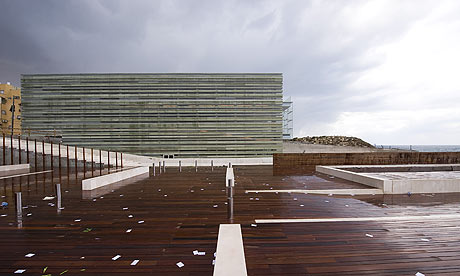
Magical and mystical ... The Peres Peace House on the Jaffa seafront in Israel. Photograph: Moreno Maggi/Fuksas

With all the ironies crushing down on it, it's amazing this building is still standing. Opening shortly after a devastating conflict, the Peres Peace House is a venue for propagating peace and improving ties between Israel and its neighbours. Furthermore, this smart new piece of architecture is named after Shimon Peres, elder statesman of Israeli politics, Nobel peace prize laureate and founder of the Peres Centre for Peace, a successful non-governmental organisation. He is also the country's president, which complicates matters. While the Peres Centre arranges for the treatment of injured Gaza children in Israeli hospitals, Peres publicly defends the military attacks that put them there.

But the Peace House could yet live up to its name. When it opens next month, the building will serve as the Peres Centre's new HQ. Its ethos is that peace in the region will be made between people, not governments, and its activities range from organising football matches between mixed Israeli and Palestinian youth teams to establishing a cross-border chamber of commerce. The new building enables the Peres Centre to host conferences, talks and arts events. It will also house Shimon Peres's personal library and archives, for the benefit of researchers and students. A one-stop peace shop, if you like. But as well as helping to achieve peace, this building had to somehow represent it - to make solid an abstract quality.

Landed with this tall but prestigious order was Italian architect Massimiliano Fuksas. Though little known in Britain, Fuksas is one of Europe's most renowned architects - an expressive innovator who would rather design with a paintbrush than a computer. His work varies wildly in style but is marked by a sculptural flair that gives rise to grand gestures and memorable forms. His recent Zenith music hall in Strasbourg, for example, is a wonky drum covered in an orange membrane that lights up at night like a lantern; his huge Milan Exhibition Centre, meanwhile, is draped in a swirling roof of steel and glass.

The Peace House is another of Fuksas's poetic one-offs, although it shows an appropriate degree of restraint. It is situated on the seafront in the ancient port town of Jaffa, just south of Tel Aviv, an area populated, peacefully, by both Israeli Arabs and Jews. In essence, it is simply a long box emerging out of the hillside. The short end, facing the sea, is a wall of clear glass; the other three sides are made up of thin horizontal bands of copper-green concrete and glass of various thicknesses, layered apparently randomly, like sedimentary rock. These strata, says Fuksas, allude to "time and patience, the stratification of the history of two peoples". The building materials, too, represent "places that have suffered heavily": solid concrete for times of stability, fragile glass for conflict and turmoil. The only clear view is out to the sea - to the future. "It is the representation of an emergency," says Fuksas of the building.

It all sounds rather literal but in reality it works marvellously. On the outside, the Peace House immediately stands out as something different - monumental yet light. To enter, you walk down from the road at the top, through a landscaped park alongside the building and round to the glass front doors facing the sea. While the walls are smooth and flat on the outside, on the inside the concrete strata project out, giving the sides an undulating, almost natural texture. Light entering between these concrete slabs illuminates the space magically, even mystically. At certain times, the low sun shines into the building, casting curious shadows, but generally it is filled with a soft, diffused glow that changes with the time of day. It feels, well, peaceful.

"I always try to do something I have never done before - that is my way," says Fuksas. "When you do a project, the first thing it has to be is useful for its tenants, but much more importantly, it has to have alchemy - like this magical light where you cannot see its origin. Because with this alchemy you have emotion. A building without emotion is not architecture."

The most dramatic space is Peres's library, at the back of the building, on the ground floor. You're basically standing underground here, since the building is half-submerged in the hillside, but an atrium rises up the back wall to skylights in the ceiling. There's a clear metaphor here - reaching upwards from the depths - but the space is powerful enough on its own terms. The other show-stopping area, and the climax of the public route through the building, is a wood-panelled auditorium on the first floor. Rather than the usual black box, its back wall is a giant window facing the Mediterranean. "If you don't want to listen to the people speaking, you can just watch the sea," says Fuksas.

The Peace House feels a bit like an inhabited monument - a beautiful art installation that unfortunately had to be divided into rooms. The interior tries its best not to disrupt the overall effect, though. In places, the upper floors don't quite touch the walls, with glass filling in the gaps. The internal divisions are also glass, where possible, although there is a concrete core running through the building containing stairs and services, plus a uniquely Israeli architectural feature: a reinforced "panic room" on each floor, a shelter in case of bomb or gas attack. Every new building in Israel is required to have them.

Building the Peace House hasn't been easy, Fuksas says. The project began more than 10 years ago - at a time when peace in the region did not seem such a distant prospect. Then, it was a joint initiative between Peres and Palestinian leader Yasser Arafat, to be situated in Tulkarem, close to the West Bank-Israeli border. After Arafat's death, it proceeded in its current form, but there were myriad problems with acquiring the site and the funding (from private donors - Peres is nothing if not well-connected). Fuksas's grand vision was not easy to translate into reality either. It was imagined that the horizontal concrete elements would be made offsite then simply stacked on to columns, like a giant child's game. But this proved to be logistically impossible. So a local architect had to work out an alternative, whereby the walls were patiently built up one layer at a time. On the metaphorical level, that's somehow appropriate.

There's still an uneasy split running through this project, though. As well as that crushing irony (Peres strives to be the big peacemaker while defending Israeli military action), the Peace House wants to be both a US-style presidential memorial library and a grassroots NGO headquarters, part gift to humanity, part vanity project. "Sometimes, this fact is awkward," acknowledges Ron Pundak, the Peres Centre's director. "But basically we are putting a very clear distance between his activity as president and our activities as the Peres Centre for Peace."

Pundak also admits to some discomfort about the prospect of receiving, say, a Palestinian partner from a refugee camp in his shiny new HQ. At present, the Peres Centre operates out of a nondescript office block in Tel Aviv, which is probably better suited to its activities. "I won't find myself very comfortable there," says Pundak of the Peace House. "But it does not reflect the Peres Centre for Peace - it reflects the vision and life and future of Mr Peres. This is the innovative approach of Mr Peres. He's not a normal politician."

Nor, it bears remembering, is Israel a normal place in which to build. Architecture has almost become an instrument of warfare in this region. There is the notorious West Bank barrier, for example, which Israel has unilaterally built (and continues to build) around Palestinian areas. Israel says the barrier has improved security against cross-border terrorist attacks; Palestinians say it severs and imprisons communities, and amounts to a land grab. Architecture has also been used as a weapon in territorial disputes. Best known are the Israeli settlements that have been built across the West Bank over the last 40 years. Israelis counter that Arabs have also built up areas, particularly around Jerusalem, in order to reinforce future territorial claims, even though many of the buildings stand empty.

Above all, of course, there is the destruction of buildings and infrastructure in Gaza, and the sisyphean task of rebuilding them. In this context, the Peace House is a much-needed contrast. Whether or not it cultivates peace, it at least sends an alternative message. Fuksas is the first to acknowledge that such expressions can easily be dismissed as hopelessly idealistic - but, he adds, that doesn't mean we shouldn't be making them. "We must never stop thinking peace is possible," he says.

..................................................................................................................................................Webmaster's Note: As a background to this article, here is the situation in Jaffa for the remnants of its original inhabitants, belying the peaceful intentions proclaimed by the Peres Peace Centre.

Unfinished Business of Ethnic Cleansing - The Expulsion of Palestinians from Jaffa

http://www.counterpunch.org/cook09152008.html

By JONATHAN COOK

September 15 2008

Jaffa.

The ground floor of Zaki Khimayl’s home is a cafe where patrons can drink mint tea or fresh juice as they smoke on a water pipe. Located by Jaffa’s beach, a stone’s throw from Tel Aviv, the business should be thriving.

Mr Khimayl, however, like hundreds of other families in the Arab neighbourhoods of Ajami and Jabaliya, is up to his eyes in debt and trapped in a world of bureaucratic regulations apparently designed with only one end in mind: his eviction from Jaffa.

Sitting on the cafe’s balcony, Mr Khimayl, 59, said he feels besieged. Bulldozers are tearing up the land by the beach for redevelopment and luxury apartments are springing up all around his dilapidated two-storey home.

He opened a briefcase, one of five he has stuffed with demands and fines from official bodies, as well as bills from four lawyers dealing with the flood of paperwork.

“I owe 1.8 million shekels [$500,000] in water and business rates alone,” he said in exasperation. “The crazy thing is the municipality recently valued the property and told me it’s worth much less than the sum I owe.”

Jaffa is one of half a dozen “mixed cities” in Israel, where Jewish and Palestinian citizens supposedly live together. The rest of Israel’s Palestinian minority, relatives of the Palestinians in the occupied territories, live in their own separate and deprived communities.

Despite the image of coexistence cultivated by the Israeli authorities, Jaffa is far from offering a shared space for Jews and Palestinians, according to Sami Shehadeh of the Popular Committee for the Defence of Jaffa’s Homes. Instead, Palestinian residents live in their own largely segregated neighbourhoods, especially Ajami, the city’s poorest district.

Only last month, Mr Shehadeh said, the Jewish residents’ committees proposed creating days when the municipal pool could be used only by Jews.

Although Jaffa’s 18,000 Palestinian residents constitute one-third of the city’s population, they have been left powerless politically since a municipal fusion with Jaffa’s much larger neighbour, Tel Aviv, in 1950. Of the cities’ joint population, Palestinians are just three per cent.

After years of neglect, Mr Shehadeh said, the residents are finally attracting attention from the authorities – but the interest is far from benign. A “renewal plan” for Jaffa, ostensibly designed to improve the inhabitants’ quality of life, is in fact seeking the Palestinian residents’ removal on the harshest terms possible, he said.

“The municipality talks a lot about ‘developing’ and ‘rehabilitating’ the area, but what it means by development is attracting wealthy Jews looking to live close by Tel Aviv but within view of the sea,” he said.

“The Palestinian residents here are simply seen as an obstacle to the plan, so they are being evicted from their homes under any pretext that can be devised.

“Some of the families have lived in these homes since well before the state of Israel was established, and yet they are being left with nothing.”

The current pressure on the residents to leave Ajami has painful echoes of the 1948 war that followed Israel’s declaration of its existence. Once, Jaffa was the most powerful city in Palestine, its wealth derived from the area’s huge orange exports.

As Israeli historians have noted, however, one of the Jewish leadership’s main aims in the 1948 war was the expulsion of the Palestinian population from Jaffa, especially given its proximity to Tel Aviv, the new Jewish state’s largest city.

Ilan Pappe, an historian, writes that the people of Jaffa were “literally pushed into the sea” to board fishing boats destined for Gaza as “Jewish troops shot over their heads to hasten their expulsion”.

By the end of the war, no more than 4,000 of Jaffa’s 70,000 Palestinians remained. The Israeli government nationalised all their property and corralled the residents into the Ajami neighbourhood, south of Jaffa port. For two years they were sealed off from the rest of Jaffa behind barbed wire.

In the meantime, Jaffa’s properties were either demolished or redistributed to new Jewish immigrants. The heart of old Jaffa, next to the port, was developed as a touristic playground, with palatial Palestinian homes turned into exclusive restaurants and art galleries run by Jewish entrepreneurs.

The Ajami district, on the other hand, was quickly transformed from a distinguished neighbourhood of Jaffa into its most deprived area, which became a magnet for crime and drugs. “The municipality showed its disdain for us by dumping all the city’s waste, even dangerous chemicals, on our beach,” Mr Shehadeh said.

The residents – even those who continued to live in their families’ original homes – lost their status as owners and overnight became tenants in confiscated property, forced to pay rent to a state-controlled company, Amidar.

Today, Amidar wants the families out to make way for wealthy Jewish investors and real estate developers.

Over the past 18 months, it has issued 497 eviction orders against Ajami families, threatening to make 3,000 people homeless.

“The problem for the families is that for six decades they have been ignored,” said Mr Shehadeh, who is standing in the local elections to the council next month.

“Four-fifths of Ajami’s population is Palestinian and no investments were made by the municipality. Amidar refused to renovate the homes, and the planning authorities refused to issue permits to the families to build new properties or alter existing ones.”

Faced with crumbling old homes and growing families, the residents had little choice but to fix and extend their properties themselves. Now years, sometimes decades, later Amidar is using these alterations as grounds for eviction, arguing that the residents have broken the terms of their rental agreements.

Mental Lahavi, vice-chairman of the local building and planning committee, recently admitted to the local media: “The municipality froze all [building] permits in the area for a long period and would not even let people replace an asbestos roof. They turned all the residents of the neighbourhood into offenders.”

Mr Khimayl has amassed large debts because he used parts of his home that, according to Amidar, were not covered by his contract – even though the house has been owned by his family since 1902.

Amidar has also been waging a legal battle over a minor alteration he made to the property.

Many years ago, Mr Khimayl rebuilt the dangerous external stone steps that provided the only access to the house’s second floor. In 2005, Amidar inspectors told him he had broken the terms of his contract and should remove the new steps.

Unable to reach his home in any other way, he replaced the stone steps with a metal staircase. Another inspector declared the staircase a violation of the agreement, too.

Mr Khimayl is currently using a metal staircase on wheels, arguing that the moveable steps are not a permanent alteration. Nonetheless, Amidar is pursuing him through the courts. Other families face similar problems.

A recent report by the Human Rights Association in Nazareth concluded the government was seeking to use a “quiet” form of ethnic cleansing, using administrative and legal pressure, to make Jaffa entirely Jewish.

Amidar has said it is simply upholding the law. “In cases in which the law has been broken, the company acts to protect the state’s rights, regardless of the value of the property or the religion or nationality of the tenants.”

Jonathan Cook is a writer and journalist based in Nazareth, Israel. His latest books are “Israel and the Clash of Civilisations: Iraq, Iran and the Plan to Remake the Middle East” (Pluto Press) and “Disappearing Palestine: Israel's Experiments in Human Despair” (Zed Books). His website is www.jkcook.net.

This article originally appeared in The National (www.thenational.ae), published in Abu Dhabi.

--------------------------------------------------------------------------------------------------------------------


Page 1 ... 7 8 9 10 11 ... 17 Next 5 Entries »