NEWS
About Us

Architects and Planners for Justice in Palestine
UK architects, planners and other construction industry professionals campaigning for a just peace in Israel/Palestine.

DATABASE & REPORTS
Tuesday
Nov102009

Jerusalem's Obstructionist Construction

The pattern of Israeli construction in East Jerusalem is meant to erase the Clinton parameters for peace.

http://www.prospect.org/cs/articles?article=jerusalems_obstructionist_construction


Jerusalem's Obstructionist Construction

Construction workers build a new apartment complex for Israelis in east Jerusalem's Jabel Mukaber, a Palestinian neighborhood. (AP Photo/Sebastian Scheiner)


So far, the bulldozers have carved a large hole in the chalky hillside for foundations. On the street, a developer's sign shows a picture of three multifloor apartment buildings that will rise on the site. The name of the developer, Bemuna, is written in Hebrew and means "in faith."

The company's Web site says the project is located in East Talpiot -- one of the Jewish neighborhoods that Israel built after it annexed East Jerusalem in 1967. That's a stretch, as I found when I visited the building site this week. The hole in the ground is surrounded by the houses of Arab a-Sawahra, a Palestinian neighborhood that borders East Talpiot. Once completed, the buildings will be three emphatic statements of Jewish presence in the neighborhood, three declarations that a political border can't be easily drawn between Arab and Jewish areas of the city.

Bemuna's project is not an isolated case. The first stage of the Nof Zion ( Zion View) development looks ready for buyers to move in. In one of the buildings, I found names written in English on two of 15 mailboxes in the lobby; the rest were still blank. Nof Zion is being marketed to Orthodox Jews from abroad. On the marketing Web site, a drawing {link: }of the full project shows that it will include a synagogue and a country club. But the project is inside Jabel Mukaber, another Palestinian neighborhood of East Jerusalem.

These projects, and many more, should be of very deep concern to Barack Obama as he prepares for Israeli Prime Minister Benjamin Netanyahu's upcoming visit to Washington. Obama has already made clear that he's committed to a two-state solution to the Israeli-Palestinian conflict. It's likely that he, Secretary of State Hillary Clinton, and Middle East envoy George Mitchell have been dusting off the most succinct American delineation of such a solution -- the parameters that Bill Clinton laid out just before he left the White House. The problem is that the Clinton parameters are being buried in construction refuse.

Clinton recognized that the city couldn't be divided along the pre-1967 lines. Too much had changed since the annexation. Physically, he said, Jerusalem should remain an open, undivided city. Politically, sovereignty should be split: "What is Arab should be Palestinian," and "what is Jewish should be Israeli." In other words, Jewish neighborhoods, including those built since 1967 in annexed territory, would remain under Israeli rule, while Palestinian neighborhoods would become part of the new state to be established in the West Bank and Gaza. According to unofficial versions of what Clinton told Israeli and Palestinian negotiators, that principle would apply to the Old City as well, difficult as it would be to work out arrangements for disputed holy sites.

The Clinton parameters assumed that Jews and Palestinians lived in distinct neighborhoods and that it would be possible -- even if not always easy -- to link those neighborhoods to Israel and Palestine. At the time, that was generally true.

But if supporters of peace took the parameters as a rough outline of a future agreement, the Israeli right has treated them as a warning. A shifting mix of government officials, commercial developers, and settler groups have done their best to make a political division more difficult. The building effort has become more intense since the Annapolis peace conference in November 2007. It's likely to accelerate further under Netanyahu -- unless a very clear warning from Obama convinces the prime minister to put on the brakes.

Part of the push is direct action by government agencies to expand Jewish neighborhoods in East Jerusalem. Immediately after Annapolis, the Israel Land Authority (ILA) announced that it was taking bids from contractors to build over 300 new units in Har Homa, a Jewish neighborhood in southeast Jerusalem. Established during the 1990s, Har Homa is placed to cut off territorial contiguity between Jerusalem's Old City and Bethlehem.

By mid-2008, the ILA and the Housing Ministry had invited bids for nearly 2000 apartments in East Jerusalem, according to a recent report by Ir Amim, an Israeli peace group that focuses on Jerusalem. The new projects expand Jewish areas, block growth of Palestinian ones, and make it harder to draw a political border in Jerusalem, the report says.

More quietly, planning authorities have approved more major developments for Israelis in East Jerusalem, and additional projects are in the planning pipeline. One of the approved developments, at Givat Hamatos on the southern side of the city, is placed to hem in the Palestinian neighborhood of Beit Safafa, cutting it off from other Palestinian areas. The plan "will make final status territorial arrangements based on the Clinton parameters in the Beit Safafa area difficult, if not impossible," the Ir Amim report says.

One major housing development has been blocked, so far. That's "E-1" -- the bureaucratic name for an area of East Jerusalem between existing Jewish neighborhoods and the suburban settlement of Ma'aleh Adumim to its east. Former Prime Minister Ariel Sharon wanted to fill the area with housing for Jews -- to create a finger of Israeli settlement that would divide the West Bank in two. According to Israeli attorney Daniel Seidemann, an expert on Israeli-Palestinian relations in the city, Sharon froze the project under pressure from George W. Bush. That's the rare exception to Bush's hands-off attitude -- and proof that U.S. pressure can work. As a candidate, Netanyahu said he'd build at E-1. A clear message from Washington is needed quickly.

The projects in Arab a-Sawahra and Jabel Mukaber, it appears, are the initiatives of private developers with a mix of commercial and ideological motives. At a minimum, though, they benefit from government acquiescence. Lest there be any confusion, the developments do not represent peaceful integration. The new buildings are self-contained complexes, just inside the Arab areas but not of them. At the same time, their purpose is apparently to obscure "what is Arab" and "what is Jewish" and prevent a political division.

The area of Jerusalem most aflame with national claims and religious passions, though, is at the center of Jerusalem -- the Old City and its immediate environs, sometimes called the "holy basin" or "historic basin." The real political battle, Seidemann argues, is over this area. And with the help of government agencies, right-wing settler groups have focused their effort on ringing the historic basin with points of Jewish settlement. Ironically, the effort implies that the right -- angrily, despite itself -- knows that Israel will give up much of the West Bank. The ring around the Old City is a final defense, intended to keep the most ancient and holy areas of Jerusalem in Israeli hands.

One focus of settler activity is the City of David, a wedge of hillside in the Arab neighborhood of Silwan. Though it is located just outside the Old City walls, the City of David area is the original location of ancient Jerusalem. A right-wing organization called Elad has conducted a two-pronged offensive in the City of David. One prong is settling Jews in the area. The other is managing the national archaeological park in the City of David, where Elad guides present an exclusively Jewish history of the area and of Jerusalem as a whole.

To the east, on the Mount of Olives, is an apartment complex called Ma'aleh Zeitim (Olive Slope) -- a Jewish enclave in the midst of the Palestinian neighborhood of Ras al-Amud. The land is owned by right-wing American businessman Irving Moskowitz, a longtime supporter of settler projects in East Jerusalem. Two buildings at the site, with over 50 apartments, were completed several years ago; two more are under construction. When I came to look around this week, a heavily armed guard at the gate asked me, "Are you Jewish?" and what I wanted. I said I was interested in the new apartments, and he allowed me in. A few moments later, another security man -- apparently his boss -- found me and told me that I'd have to arrange in advance with a sales agent to visit.

When the first settlers moved in at Ma'aleh Zeitim, apparently in 2003, an article on a settler news site explicitly described the purpose of the project: Foiling diplomatic plans to allow free Palestinian access to the Temple Mount (and al-Aqsa Mosque) without passing through Jewish areas.

Foiling diplomacy, indeed, is the shared purpose of all these projects: rendering the Clinton formula irrelevant, blocking the political division of Jerusalem, and thereby eliminating a two-state solution.

For Obama, there are several implications: First, every bulldozer, crane, and cement mixer ignored today will make an agreement more difficult later. An immediate freeze on Israeli construction in East Jerusalem is essential for any diplomatic process.

Second, Obama can reasonably cite the Clinton parameters as a basis for peace. But the definition of "what is Arab" and "what is Jewish" can't be fluid, dependent on the latest housing starts. It needs to be attached to a date -- the end of 2000, or at an absolute minimum, today. What has been built, or is built, after that date, should not be part of the American proposal for political lines in Jerusalem.

To put it simply, Netanyahu should know that building Jewish enclaves in Arab a-Sawahra or Ras al-Amud won't change the borders. Anyone buying an apartment in those enclaves will eventually end up leaving or living under Palestinian sovereignty. Anyone selling those apartments -- and any official approving them -- is acting in bad faith.
 

Tuesday
Oct132009

Architecture as the continuation of politics: White City, Dark City

By V.G. Smith

10 February 2009
http://www.wsws.org/articles/2009/feb2009/lett-f10.shtml

While Israeli tanks and bombs hit Gaza, a sales video for an apartment tower in Tel Aviv, 40 miles north of Gaza City, pitches the "Neve Tsedek White City Residence." As photos roll, the voice describes the tower in the heart of the "vibrant cosmopolitan city" of Tel Aviv; it cites "luxurious apartments," even a penthouse designed by Armani Casa, Milan, a "sophisticated lobby, lounge, and business rooms" for new enterprises. Sharing the same Mediterranean coast, Gaza City and Tel Aviv offer a brutal display of contrasts.

There is no need for conference rooms in Gaza, since 80 percent of inhabitants live under the poverty level, and 38 percent are unemployed. No call for penthouses by Armani, Milan, in Palestinian houses destroyed by US-supplied F16s. No sophisticated lobby for shelter, but refugee camps and darkened homes without electricity. While residents of the "White City" tower will enjoy sea views, Gaza inhabitants experience a blockade and see gunboats that occasionally fire "practice" shots inland, which last year killed a family picnicking on Gaza Beach. Where is the truth about these two towns?

The myth of Tel Aviv as "the White City" rests on the importation of style characteristics from European Modernism into Israel, and the number of Israeli architects educated or practicing in the "International style." This last connection centers largely on Arieh (not Ariel) Sharon, who studied with Hannes Meyer at the Bauhaus. The myth supports the presentation of Israel as a sophisticated, modern nation, understanding and willing to further goals of harmony and peace—a better life.

Those were the goals underlying buildings of the Modern Movement in Europe in the 1920s, practiced primarily in the Netherlands, Germany and France. The myth started in 1959 at the 50th anniversary of Tel Aviv, progressed in the 1980s through museum exhibitions in Tel Aviv and their publications; in 2003, the district was declared a World Heritage Site by UNESCO; and continued most recently in the Netherlands with an exhibition from Israel at the Technical University of Delft in September entitled "Revival of the Bauhaus in Tel Aviv," introduced by the Cultural Attaché of the Embassy of Israel.

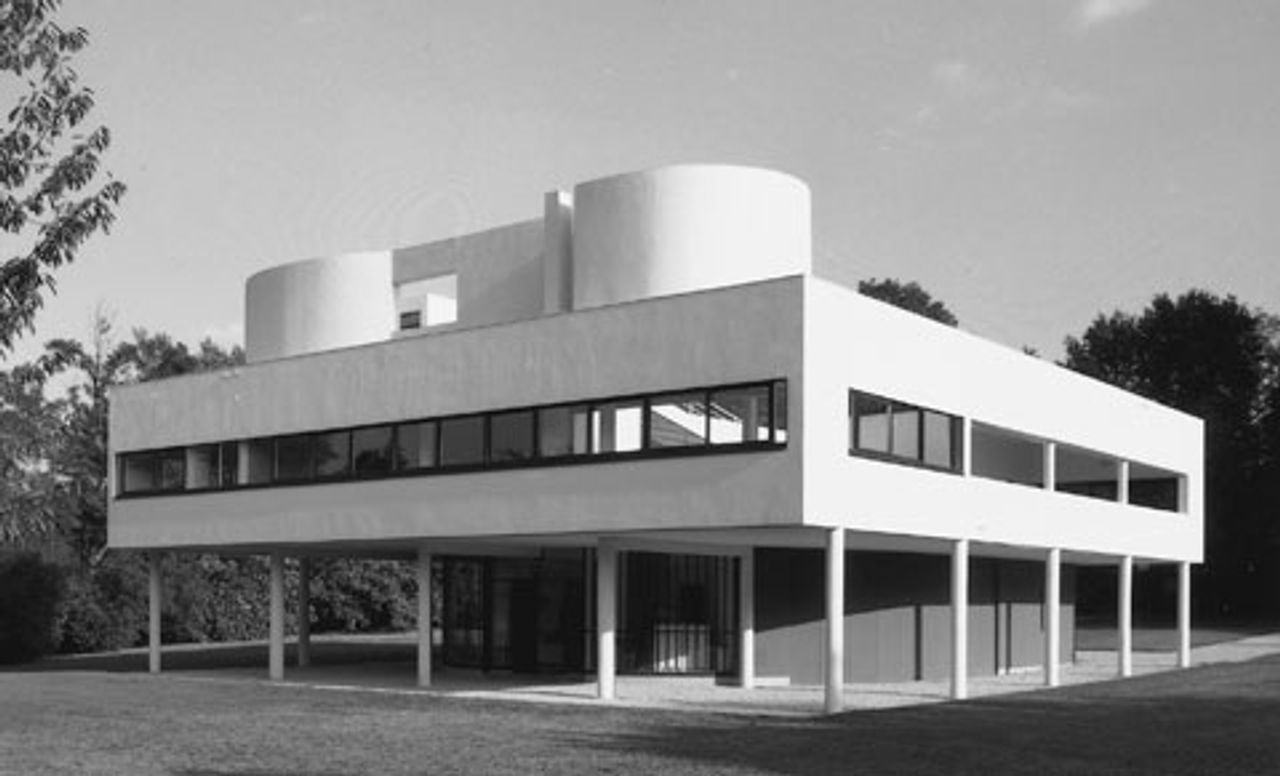
Completed in Poissy, outside Paris, France, in 1929, LeCorbusier's Villa Savoye provides an iconic representation of early modernism, incorporating the five points which the architect used to define this "entirely new kind of building": columnar structure, roof gardens, open plan, horizontal window and free design of the facade.

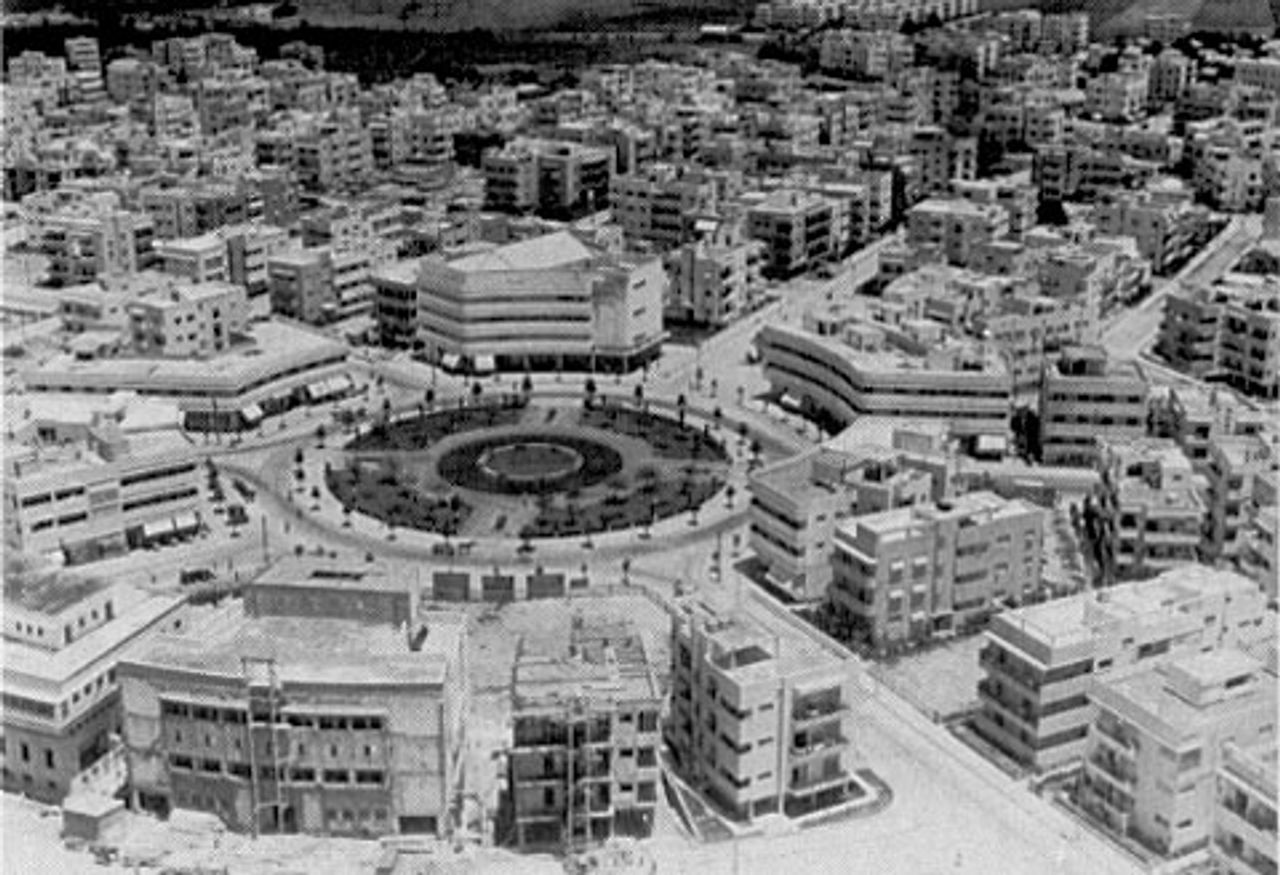
In the construction boom of the 1930s, virtually all of Tel Aviv was built in the "International Style," understood here as white walls, flat roofs and massing of cube-like blocks, sometimes raised on columns. Conditions favored this style. Concrete construction was cheap and used unskilled workers. Buildings raised on columns like Corbusier's pilotis worked especially well in Tel Aviv because they allowed sea breezes to pass through. Flat roofs are not alien to Canaan, but stem from ancient tradition; David lusted after Bathsheba from his roof, and later, Jesus healed the man on a litter whose friends cut a hole in the roof to let him down (Mark 2:4). The Eastern aspect of Tel Aviv has been acknowledged and sometimes surfaces in White City "International" construction—atriums with splashing pools (not German), cupolas, tall arches, occasional ogees and ornament.

The International Style can be understood as a vocabulary of forms or as a social movement to achieve a better life through architecture. Its iconic buildings in Europe manifest both. Betondorf, a 1920s white concrete village outside Amsterdam, admitted only socialists, and provided a village green with adjoining library, but banned bars and churches. During a visit last autumn, it appeared to be still happily inhabited. The movement inspired sanitariums with balconies for TB patients, workers' housing projects, open-air schools and orphanages. The style allied architecture with a conscience.

Today, there are two architectures in Israel, as there are two politics. There are peace movements in Tel Aviv, and elsewhere in the land, and there are extremists, defiant of the law, even the laws of their own courts and certainly that of the UN. So there is another architecture alongside the imported/borrowed-International/Bauhaus style. It is the architecture of the outposts: wall and tower.

In July 2002, two Israeli architects won a competition within the Israeli Association of United Architects to produce an exhibition of Israeli architecture in Berlin. It was a trenchant critique of the architecture of occupation. When a spokesman for the Interior Ministry reviewed the exhibition the day before its shipment, he became enraged, demanding that the exhibition be cancelled and all the catalogs shredded.

The architects themselves revised and published the catalog as A Civilian Occupation (Verso, English edition 2003). In the catalog, they map the spread of settlements in the West Bank and document through photographs a new native building type, a hasty ensemble of a wall, a tower and dwellings. The wall area outlines and claims the territory, usually a hilltop, and the tower allows surveillance of the surroundings. The dwellings housed pioneer settlers. This model was favored by Ariel (the Prime Minister) Sharon when he constructed an upscale wall-and-tower residence on land allegedly taken from a Palestinian farmer.

As Israel continues its aggression on Palestinian land, wall-and-tower architecture appears as its authentic voice. To mimic International Style characteristics is as false as the nation's imitation of a modern state. Claiming a free press, it controls journalists at gunpoint at the Gaza border; having established a court system, it ignores its rulings; boasting of cosmopolitanism, it shuts down airports and forbids Palestinian travel—somehow in imitating Modernism it has violated all the beliefs of what was truly the spirit of Modernism, that of social justice.

V.G. Smith is a designer and design historian, and Professor Emerita of Art at City University of New York.

from World Socialist Website

www.wsws.org


Friday
Sep252009

An Israeli settlement in close-up, and what is in its shadow

View of Givat Ze'ev from Agan Ha'ayalot (photo by Martin Asser/BBC)
Givat Ze'ev is sprouting a new neighbourhood several hundred metres away

As Israeli, Palestinian and US leaders meet again in the long-running saga of Middle East peace talks, the BBC's Martin Asser examines one of the thorniest issues on the agenda. In the first of two articles, he visits an Israeli settlement in the West Bank undergoing a major expansion.

They come in many shapes and sizes - hardline colonies deep in the West Bank, farmsteads in the Jordan valley, leafy towns within commuting distance of Tel Aviv and large developments in East Jerusalem.

But the Jewish settlement Givat Ze'ev, situated on a picturesque, undulating plain 10 minutes' drive from the northern outskirts of Jerusalem, is more dormitory town than ideological outpost.

Built, like all settlements, in defiance of international law on land captured in 1967, its location is strategically important, south of Israel's Highway 443 cutting into the West Bank for 20km to connect Tel Aviv with Jerusalem.

Yuval (photo by Martin Asser/BBC)
Apartments are cheap and the air is good. You live close to the city but you feel you are in a village
Yuval, Givat Ze'ev resident

Its population is 12,000, mostly from the liberal end of the spectrum, with an Orthodox Jewish satellite on the west side. It is the fifth largest West Bank settlement and one of the fastest growing.

Although Israel agreed to freeze settlement activity under the Roadmap peace plan, Givat Ze'ev has 750 extra housing units approved, about half of which are nearing completion and awaiting their first occupants.

Little distinguishes the settlement from any Israeli town, except a low-key security post with an open gate at the entrance.

Palestinian villages surround it, but any violence has diminished markedly as those villages are now on the other side of a wide loop of Israel's West Bank barrier around the settlement.

Pragmatic population

Givat Ze'ev has a friendly small-town atmosphere - young and old mill around a row of shops and cafes on the main street; a medical centre and a hairdresser do brisk trade.

Although Israel's settlement movement was born to advance sovereignty in the occupied territories, there was no sign - among people I spoke to - of political motives underpinning their presence.

GIVAT ZE'EV
Givat Ze'ev (photo: Martin Asser/BBC)
Founded in 1982
Named after right-wing Zionist leader Ze'ev Jabotinsky
Population 12,000 (approx) including 35% religious Jews
Six elementary schools, one junior high school

On the contrary, people mentioned affordable accommodation, that it was a good place to live and raise children, getting around was easy via 443 and other bypass roads for Israelis.

"I came here 14 years ago to enjoy quality of life," said Yuval, who did not give his second name. "Apartments are cheap and the air is good. You live close to the city but you feel you are in a village."

Everyone asserted their absolute right to live in what they considered part of Israel obtained legitimately, in their view, through conquest. One elderly man said it was the West Bank only "on paper, not in life".

But when asked if they'd be prepared to surrender their homes to enable a two-state peace deal with Palestinians, most said yes, as long as there was proper compensation.

However, there was deep scepticism that peace was possible, or that Givat Ze'ev and other settlements around Jerusalem would be forfeited to create a Palestinian state.

Diplomatic dispute

For four decades, Israeli governments have supported Jewish settlement in the West Bank, a place with strong links to Judaism and, until Jordan took control in 1948, a significant Jewish presence. The state provides funding and infrastructure, and a blanket of security from the military.

Since 1967, the Jewish population has gone from zero to about 300,000 in the West Bank and 200,000 in East Jerusalem.

Numbers have grown 5% annually since Israel signed the Oslo peace accords in 1993 - despite a stipulation that neither it nor the Palestinians took any action prejudicing the final resolution.

Lately, however, Israel's closest ally, the US, has added weight to its erstwhile diplomatically worded objections to settlement expansion.

"The US does not accept the legitimacy of continued Israeli settlements. It is time for these settlements to stop," President Barack Obama said in a speech in Cairo in June.

Israeli Prime Minister Benjamin Netanyahu has resisted firmly this new tougher line, one of his chief arguments being that settlements must be allowed "natural growth".

In other words, younger generations of Jews shouldn't be squeezed out because they want to start families, and amenities - kindergartens, synagogues etc - must be built as required.

New development

In Givat Ze'ev's case, new construction is going on apace in an area Israelis know as the Ha'ayalot valley, which was confiscated from neighbouring Palestinian villages whose inhabitants call it Wadi Salman.

Agan Ha'ayalot (photo by Martin Asser/BBC)
Agan Ha'ayalot is isolated from the rest of the settlement near the separation barrier

Work started in 1999, but stopped in 2000 when the violence of the second Palestinian intifada put settlers off wanting to live in what is quite an exposed spot.

Each side of the valley is topped by Palestinian houses and it extends west from the main body of the settlement, with the first new houses located 700m away - or 2.5km by a winding road.

Construction in the Agan Ha'ayalot, as it is known, resumed in 2008, following completion of a section of the barrier which passes through the valley in a series of hairpin bends cut deep into the rock.

Homes in the three dozen apartment blocks have been marketed to ultra-Orthodox families whose strict religious observance means they prefer not to live among secular or more liberal Jews.

"It's not normal or natural growth, it's a dramatic expansion for a new kind of population," says Hagit Ofran, of the Israeli group Peace Now, which campaigns against settlements.

She argues that every new Jewish home in the West Bank makes "the cost of a two-state solution higher".

"We should be in the process of getting an agreement [with the Palestinians] and not building obstacles likes this," Ms Ofran says.

Mr Netanyahu has ruled out anything but a possible "scaling down" of settlement activity. Palestinian leader Mahmoud Abbas says substantive negotiations cannot resume without a complete freeze.

In the second half of this investigation we shall see how members of the Palestinian population around Givat Ze'ev view the situation.

  --------------------------

22 September 2009

In the shadow of an Israeli settlement

Givat Ze'ev settlement, seen through West Bank barrier (photo Martin Asser/BBC)
Givat Ze'ev settlement is separated from local Palestinians by Israel's West Bank barrier

Extensive diplomatic efforts towards reviving Mid-East peace talks have yielded little. The US has continued to demand Israel freeze settlement activity in the West Bank, while Palestinians refuse to negotiate without a freeze.

In the second of a two-part investigation, the BBC's Martin Asser sees the effect of settlements on the lives of Palestinians.

They are called the Seven Villages, situated north-west of Jerusalem where the West Bank hills fall away towards the Mediterranean.

SEVEN VILLAGES POPULATIONS
Beit Anan - 4,264
Beit Duqqu - 1,600
Beit Ijza - 671
Beit Surik - 3,818
Qubeiba - 2,069
Qatanna - 7,496
Source: Palestinian Authority (2006)

Though their inhabitants live within the Palestinian Authority's Jerusalem governorate, few get to visit Jerusalem - though the city was "like a mother to us" one man said.

While Israelis in nearby Givat Ze'ev settlement bloc zip to Jerusalem by car in minutes, the Palestinian villagers need permission from Israel's military authorities.

If they don't get permission, apparently the norm, there are roundabout ways past Israel's defences and into the city, but this risks jail and a stiff fine.

Israel says all restrictions are imposed to prevent Palestinian militants wreaking havoc with suicide bombings.

But, the Seven Villages is known as a quiet area. Israeli soldiers I spoke to said there was very little militant activity.

Palestinian residents insist they are peaceable folk - famers, labourers, some professionals - who just want to live normal, decent lives.

Enclosed lives

Everyone I met said their world was dominated by Israel's occupation of the West Bank, in place since the 1967 war.

After occupation came Jewish settlements; after the violent Palestinian uprising of 2000 came Israel's vast infrastructure to protect the settlements. Now villagers in this area of the West Bank are hemmed in on all sides.

To the West and South Israel's West Bank barrier follows roughly the pre-1967 border. To the East it snakes deep into the territory around Givat Ze'ev. To the North is the heavily defended Highway 443, connecting northern Jerusalem to Tel Aviv.

There are two official exits: via a 1.3km-long sunken road through the Givat Ze'ev loop towards Ramallah, and via Beit Iksa village towards Jerusalem.

West Bank map

The recently completed underpass - built on confiscated Palestinian land - made a significant improvement on the tortuous route people used to take to the West Bank's main city.

But simultaneously, Israel built a military checkpoint on the road to Beit Iksa, and now only its residents can pass.

Many villagers were concerned that, although the underpass undoubtedly made life easier, it also made it easier for Israel to lock down the whole area with a very small military deployment.

High price

While Palestinians insist the barrier is part of a land grab, Israelis officials say its purpose is purely defensive and, furthermore, temporary so it could be removed if peace breaks out.

Mahmoud Salim
Mahmoud Salim's lives in the "security zone" beside the West Bank barrier

But it has already taken a heavy price in the Seven Villages.

I met Mahmoud Salim on his way from Beit Ijza to the centremost village of Biddu to pay his electricity bill.

His house is located in a security zone for the barrier, which passes 15 metres away. His farmland lies on the other side and he has been told by the army he cannot "put one stone on another" in what's left of his garden.

He remembered the day in 2004 when Israeli troops first came to secure the area.

"People wanted to defend their land, but troops opened fire as though faced by another army. My son was the first one killed, though he wasn't involved in the demonstrations."

He is not the only such case in the Seven Villages. I met another man by chance in Beit Duqqu whose brother was killed in the same clashes.

Security anomalies

Some villagers, thanks to the barrier, find themselves in positions of such extraordinary and precarious absurdity you can scarcely believe what you're seeing.

Sabri household, Beit Ijza (photo Martin Asser/BBC)
The Sabri family home is in the middle of an elaborate high-security installation

The Sabris live on the east side of the barrier, embedded in a small settlement south of Givat Ze'ev, but completely surrounded by a six-metre-high wire fence.

Their simple hilltop house is reached by a stark concrete bridge over the barrier, which is dug into the rock below.

The bridge is controlled by a massive steel gate operated remotely by troops in the Atarot base 5km away.

To begin with, the family said, soldiers dutifully closed the gate at night, but now it stands open all the time. One can only guess how much this arrangement added to the cost of the barrier (estimated overall to be $1.3bn).

They talk about a settlement freeze, but they've forgotten the occupation. If we got rid of that, the settlements would go
Schoolteacher, Beit Duqqu

On the other side of Givat Ze'ev, to the east, I met the Najadas, whose house lies in a "security zone" between the barrier and the settlement, cut off from their nearest village, al-Jib.

To get to work or school in the village, they walk along the security road next to the barrier to the nearest checkpoint. They cannot use cars or keep goats and have given up the idea of getting their crops to market.

I witnessed Abdul Baset Najada being told by checkpoint guards he couldn't walk along the road, although we were allowed to take him by car.

Disagreement

The people I spoke to seemed unimpressed by Palestinian leader Mahmoud Abbas's stance that peace talks cannot resume with Israel unless settlement construction ends.

"The papers are all talking about freezing settlements, but they've forgotten the occupation. If we got rid of that, the settlements would go," said a schoolteacher in Beit Duqqu.

Many see Mr Abbas as dancing to Israel's tune, while in their view settlements on 1967 land should not just stop growing, but should be removed completely.

Beit Duqqu is considered particularly affected by the expansion of Givat Ze'ev, one of the fastest growing Jewish settlements.

The village lies just across the valley from the Agana Ha'ayalot development, and it isn't hard to imagine its new Orthodox Jewish residents coming under militant attack from snipers or infiltrators one day.

"God help us if any settler gets hurt," says the schoolteacher, adding with a chuckle: "Maybe there will be an earthquake and we'll all be down in the valley."

----------------------------


Wednesday
Sep162009

Colonial Tel Aviv - the truth about Israel's prime Zionist City

 Colonial Tel Aviv

http://jewssansfrontieres.blogspot.com/2009/09/colonial-tel-aviv.html

September 11, 2009

The public letter to the TIFF (Toronto International Film Festival) says

In 2009, TIFF announced that it would inaugurate its new City to City program with a focus on Tel Aviv. According to program notes by Festival co-director and City to City programmer Cameron Bailey, “The ten films in this year’s City to City programme will showcase the complex currents running through today’s Tel Aviv. Celebrating its 100th birthday in 2009, Tel Aviv is a young, dynamic city that, like Toronto, celebrates its diversity.”

The emphasis on ‘diversity’ in City to City is empty given the absence of Palestinian filmmakers in the program. Furthermore, what this description does not say is that Tel Aviv is built on destroyed Palestinian villages, and that the city of Jaffa, Palestine’s main cultural hub until 1948, was annexed to Tel Aviv after the mass exiling of the Palestinian population. This program ignores the suffering of thousands of former residents and descendants of the Tel Aviv/Jaffa area who currently live in refugee camps in the Occupied Territories or who have been dispersed to other countries, including Canada. Looking at modern, sophisticated Tel Aviv without also considering the city’s past and the realities of Israeli occupation of the West Bank and the Gaza strip, would be like rhapsodizing about the beauty and elegant lifestyles in white-only Cape Town or Johannesburg during apartheid without acknowledging the corresponding black townships of Khayelitsha and Soweto. ( Indiwire)

That hits home, but there is more. Tel-Aviv has an international reputation based on the myths the tells itself about its own identity and history. Tel-Aviv is the opposite of the settlements, the opposite of crazy Jerusalem, of the fanatics of Hebron, it is an oasis of sanity and tolerance. Meir Wieselthier, an Israeli poet, expressing the “anti-war” Tel-Aviv ethos, once said that he would only take up arms if a foreign army were about to cross the Yarkon (a river at the northern side of Tel-Aviv). The singular most important idea about Tel-Aviv is that it is innocent. It is not on occupied land (it was supposedly built on sandy dunes). It has nothing to do with the fanaticism that drives the violence of the occupation. It is secular, young, hedonistic, worldly and diverse. Perhaps it is a tad too materialistic. But when the alternative is the spirituality of a Baruch Goldstein, even crass materialism looks awfully benign.

It’s a good story with fetching characters. But it is also false. Let’s take the issue of diversity first. Although 20% of Israeli citizens are Palestinians, only 4.2% of Tel-Aviv residents are. For a major city, that is an impressive lack of diversity. Moreover, almost all these Palestinians live in a few segregated neighborhoods in the far end of Jaffa, mostly Ajame. Excluding these marginal and poor neighborhoods at the edge of the city, Tel-Aviv is almost completely free of Arabs. As such, the city no doubt constitutes a demographic miracle. The below-margin-of-error percentage of Arabs in this “diverse,” bustling, Mediterranean metropolis is lower than in Paris, Geneva, London, or Brooklyn.

That "diversity" makes Tel Aviv a rare example of successful ethnic cleansing. Until its destruction, Jaffa was an important hub city in the Arab Mediterranean. Today it is home to less than 1% of Palestinians with Israeli citizenship, a marginal and isolated community. Jaffa was conquered by the Jewish paramilitary organizations in 1948 and over 60,000 of its residents were forced to leave as as a result of the shelling of the city. They were literally “thrown into the sea” and had to sail, mostly to Gaza. The conquerors then proceeded to bulldoze 75% of the city. The Ajame and Jebaliah neighborhoods were left standing, with less than 4,000 Palestinians allowed to remain. The area was left to deteriorate and become a dumping ground for municipal waste and a zone for crime and drugs. Moreover, the houses were confiscated and the remaining Palestinians became tenants of the state housing agency, Amidar, which neglected the properties and even refused to let the residents upgrade them on their own. The final turn of the screw in this cruel tale came with the new millennium. As Tel Aviv enjoyed a finance driven speculative real-estate boom, Ajame became attractive for real-estate developers. The obstacle was, of course, how to get rid of existing tenants. Amidar’s ingenious solution was to impose fines on the tenants for illegally upgrading and repairing their homes, and then offer to forgive the debt in return for evacuation. (See Jonathan Cook, Jaffa Renewal plan aims at eviction)

Another part of town, the Old City, ethnically cleansed to the last, and most of its urban space destroyed, leaving only the outer wall and a few Christian landmarks, was turned into a touristic and nightlife attraction. The original Arab street names have been erased, and the Tel-Aviv municipality is happy to let you know that “the alleys of Old Jaffa are named after the signs of the Zodiac and it is possible to find there artists galleries and Judaica shops, jewelry and art from top ranking artists”.(http://www.tel-aviv.gov.il/english/tourism/sites/jaffa.htm). Read that touristic blurb in vain for any mention of Jaffa’s past and its demise. Napoleon’s visit is the only historical event worthy of the tourist’s knowledge; the mark of the fleeting footsteps of a great White Man being more important than the whole of local history. Not mentioned is that Napoleon’s stay included a thirty hour long butchery and rape of the local civilian population followed by the massacre of 4.500 prisoners of war. That is not history, apparently since it did not happen to European Jews.

The artist galleries, property of dispossessed Palestinians, were distributed by the state to Israeli artists. You need to file an application to get one. This is one of the ways in which the intellectuals and bohemians of Tel-Aviv have been inducted, made accomplices in the ethnic cleansing of Palestine and given a solid stake in the preservation of a Jewish State. Sooner or later someone will make a list of these towering moral lights, most of them probably self-identifying as members of the “peace camp”, who accepted these gifts. But I’ll mention one famous name as an emblem. Dan Ben-Amotz was a first generation bohemian and writer (he was member of the elite Palmach unit in 1948) who in many ways typified the secular Tel-Aviv-ish brand identity and even played an important role in fashioning it. He was a handsome celebrity, went to Hollywood, befriended Marlon Brando, acted in Israeli films, including one of the most critical ever made in Israel about Zionism (Uri Zohar’s A Hole in the Moon), wrote long profane novels about his sexual exploits, pioneered the Tel Aviv nightlife and club scene, studied Hebrew slang and profanities, was “anti-war” before it was fashionable, ridiculed Israel’s shibboleths in the name of individual expression and put the ‘carnal’ in “make love not war.” Nationalist and religious fanaticism was as meaningful to his persona as coconuts are to the Inuit diet. His first wife was Christian and his signature dress code was an Arab galabiyeh. In addition to being a fixture of Tel-Aviv and a symbol of its anarchic and individualistic streak, Ben-Amotz also took part in creating the Tel-Aviv myth. In 1980 he co-wrote a play that celebrated the establishment of first “Hebrew City.” Yosef Rachelski, an Israeli cultural critic, called him one of the two most influential cultural icons of Israel in the late sixties, the other being Moshe Dayan.

Ben-Amotz lived in an Arab house in Old Jaffa overlooking the mediterranean sea; he also owned valuable commercial property in the area that the conquerors destroyed. After his death a scandal broke out involving rumors about his sexual mores, not always consensual. But there was never a scandal about his real estate transactions, also apparently not always consensual. Ben Amotz’s irreverent and insouciant enjoyment of the racist order he mocked is a symbol of secular and fun loving Tel-Aviv’s relation to the apartheid system of israel.

As architect Sharon Rotbard, who wrote a magisterial book excavating Tel-Aviv's hidden story, and whose insights I plunder here with abandon, claims,

Tel aviv was not born from the sand. It was born in Jaffa. Yet, its attitude to Jaffa reminds one of the Christian attitude to Judaism, including contradictory violent elements of birth and matricide, continuity and separation, inheritance and appropriation, erasure and masking, guilt and exculpation. From the moment the first Jewish neighborhood Neve Tzedek was born from the womb of the “Bride of the Sea,” in the eighties of the nineteenth century, Tel-Aviv never ceased to flee from Jaffa and to persecute Jaffa. The war of [creating a] “white city,” over conquering the symbolic and historic space of the metropolis, is the war of Tel-Aviv against Jaffa and her biological daughters and step-daughter….to create that Tel-Aviv of street and grocery shop and invent the normality of a house, a courtyard and a staircase, Tel-Aviv eradicated a whole [urban] space. It conquered Jaffa and her daughters, emptied them of their residents, eradicated neighborhoods, villages, roads and landscapes, destroyed places, houses, streets, public monuments…In doing so, Tel-Aviv erased the memory of Jaffa. The war did not end with the 1948 conquest and exile of the residents. It continues to this very day. Although Jaffa is a dead city, Tel-Aviv still tortures her corpse…From its inception as a city separate from Jaffa, and in its cultural, ethnic and now historical construction as a “white city,” Tel-Aviv constituted itself through its opposition to Jaffa, as separation from Jaffa, as the dialectical negation of Jaffa. For Jaffa, this dialectic relation was no less fateful. While Tel-Aviv built and wrote itself, it also destroyed and erased Jaffa, fashioning it as its own negation – a city of the night, neglected, criminal, dirty, derelict, and black. (White City Black City [Hebrew], p.126 )


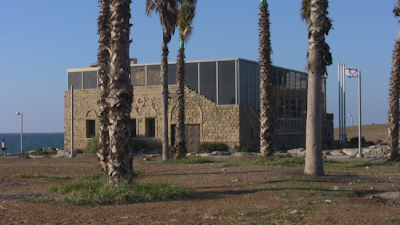
The Museum of The Irgun houses an educational collection about the terrorist organization,
its means, strategiesand achievements. The building makes an unambiguous statement:
the modern, corporate,glass-and-steel Israel rising out of the hollowed husk of an Arab
house in the area where the Manshiyeh neighborhood once stood.

Finally, there is the question of dates and origins. Where to begin? What to choose as year zero? What does it mean, for example, to tell the history of the Americas from 1492? What is the meaning of 1909 as the date of the “beginning” of Tel Aviv? What exactly was born in 1909? Was it the point of departure of the urban habitat that is today Tel-Aviv-Yafo? No, since Jaffa has always been there, and Jaffa has been included in Tel-Aviv-Yafo, the history of urbanism in the area does not start in 1909. Was it the beginning of Jewish habitation? No. Leaving aside why a “diverse” modern city should be celebrated based of a single ethnic identity, Jews have always been residents of Jaffa. Was it then the first organized Jewish settlement in the area? No. Neve Tzedek was established in 1887 by Palestinian Jews from Jaffa. Kerem Hateimanim was established in 1905. Jews from Jaffa and from Yemen established Jewish neighborhoods near Jaffa because Jaffa was overcrowded. These Jewish suburbs of Jaffa were incorporated later into Tel-Aviv and allowed to become derelict slums as symbolic punishment for their guilty proximity to Jaffa, geographically as well as culturally. In the same period Muslims established a largely Muslim neighborhood to the north of Jaffa, Manshiyeh, that was completely erased in 1947 (a single mosque is all that remains today, near a parking lot called "the conquerors").

1909 is an arbitrary date, chosen, according to Sharon Rotbard, mostly because of the convenient existence of a commemorative photograph of the land ruffle for the establishment of the neighborhood Ahuzat-Bait. What distinguishes this neighborhood, not only from Jaffa and the Palestinian villages but also from the older Jewish neighborhoods, is that it was established by white European Jews. It is on the basis of this distinction that the history of Tel-Aviv was written and transformed into a myth of a city created on sands, separate from the natives, and therefore paradoxically pure and innocent of the bloody history of apartheid. The principles of segregation that would lead to an apartheid regime thus becomes the foundation of the claim of innocence relative to that apartheid. Tel-Aviv is innocent because it is a pure European city! Events celebrating the 1909 birth of Tel-Aviv are thus not only inappropriate homage to the financial capital of an apartheid state. They are not only attempts to white wash the massacre of Gaza. They are also opportunities for legitimizing colonialism through the commemoration of the arrival of white Europeans to the orient. By celebrating Tel-Aviv, and especially by claiming the right to separate the city from the conflict and thus confirm its image of innocence and “diversity”, Western curators are able to pay homage to colonialism and justify its role in their own societies.

Bookmark and Share

Sunday
Sep132009

Architecture as the continuation of politics: White City, Dark City

By V.G. Smith

10 February 2009
http://www.wsws.org/articles/2009/feb2009/lett-f10.shtml

While Israeli tanks and bombs hit Gaza, a sales video for an apartment tower in Tel Aviv, 40 miles north of Gaza City, pitches the "Neve Tsedek White City Residence." As photos roll, the voice describes the tower in the heart of the "vibrant cosmopolitan city" of Tel Aviv; it cites "luxurious apartments," even a penthouse designed by Armani Casa, Milan, a "sophisticated lobby, lounge, and business rooms" for new enterprises. Sharing the same Mediterranean coast, Gaza City and Tel Aviv offer a brutal display of contrasts.

There is no need for conference rooms in Gaza, since 80 percent of inhabitants live under the poverty level, and 38 percent are unemployed. No call for penthouses by Armani, Milan, in Palestinian houses destroyed by US-supplied F16s. No sophisticated lobby for shelter, but refugee camps and darkened homes without electricity. While residents of the "White City" tower will enjoy sea views, Gaza inhabitants experience a blockade and see gunboats that occasionally fire "practice" shots inland, which last year killed a family picnicking on Gaza Beach. Where is the truth about these two towns?

The myth of Tel Aviv as "the White City" rests on the importation of style characteristics from European Modernism into Israel, and the number of Israeli architects educated or practicing in the "International style." This last connection centers largely on Arieh (not Ariel) Sharon, who studied with Hannes Meyer at the Bauhaus. The myth supports the presentation of Israel as a sophisticated, modern nation, understanding and willing to further goals of harmony and peace—a better life.

Those were the goals underlying buildings of the Modern Movement in Europe in the 1920s, practiced primarily in the Netherlands, Germany and France. The myth started in 1959 at the 50th anniversary of Tel Aviv, progressed in the 1980s through museum exhibitions in Tel Aviv and their publications; in 2003, the district was declared a World Heritage Site by UNESCO; and continued most recently in the Netherlands with an exhibition from Israel at the Technical University of Delft in September entitled "Revival of the Bauhaus in Tel Aviv," introduced by the Cultural Attaché of the Embassy of Israel.

Completed in Poissy, outside Paris, France, in 1929, LeCorbusier's Villa Savoye provides an iconic representation of early modernism, incorporating the five points which the architect used to define this "entirely new kind of building": columnar structure, roof gardens, open plan, horizontal window and free design of the facade.

In the construction boom of the 1930s, virtually all of Tel Aviv was built in the "International Style," understood here as white walls, flat roofs and massing of cube-like blocks, sometimes raised on columns. Conditions favored this style. Concrete construction was cheap and used unskilled workers. Buildings raised on columns like Corbusier's pilotis worked especially well in Tel Aviv because they allowed sea breezes to pass through. Flat roofs are not alien to Canaan, but stem from ancient tradition; David lusted after Bathsheba from his roof, and later, Jesus healed the man on a litter whose friends cut a hole in the roof to let him down (Mark 2:4). The Eastern aspect of Tel Aviv has been acknowledged and sometimes surfaces in White City "International" construction—atriums with splashing pools (not German), cupolas, tall arches, occasional ogees and ornament.

The International Style can be understood as a vocabulary of forms or as a social movement to achieve a better life through architecture. Its iconic buildings in Europe manifest both. Betondorf, a 1920s white concrete village outside Amsterdam, admitted only socialists, and provided a village green with adjoining library, but banned bars and churches. During a visit last autumn, it appeared to be still happily inhabited. The movement inspired sanitariums with balconies for TB patients, workers' housing projects, open-air schools and orphanages. The style allied architecture with a conscience.

Today, there are two architectures in Israel, as there are two politics. There are peace movements in Tel Aviv, and elsewhere in the land, and there are extremists, defiant of the law, even the laws of their own courts and certainly that of the UN. So there is another architecture alongside the imported/borrowed-International/Bauhaus style. It is the architecture of the outposts: wall and tower.

In July 2002, two Israeli architects won a competition within the Israeli Association of United Architects to produce an exhibition of Israeli architecture in Berlin. It was a trenchant critique of the architecture of occupation. When a spokesman for the Interior Ministry reviewed the exhibition the day before its shipment, he became enraged, demanding that the exhibition be cancelled and all the catalogs shredded.

The architects themselves revised and published the catalog as A Civilian Occupation (Verso, English edition 2003). In the catalog, they map the spread of settlements in the West Bank and document through photographs a new native building type, a hasty ensemble of a wall, a tower and dwellings. The wall area outlines and claims the territory, usually a hilltop, and the tower allows surveillance of the surroundings. The dwellings housed pioneer settlers. This model was favored by Ariel (the Prime Minister) Sharon when he constructed an upscale wall-and-tower residence on land allegedly taken from a Palestinian farmer.

As Israel continues its aggression on Palestinian land, wall-and-tower architecture appears as its authentic voice. To mimic International Style characteristics is as false as the nation's imitation of a modern state. Claiming a free press, it controls journalists at gunpoint at the Gaza border; having established a court system, it ignores its rulings; boasting of cosmopolitanism, it shuts down airports and forbids Palestinian travel—somehow in imitating Modernism it has violated all the beliefs of what was truly the spirit of Modernism, that of social justice.

V.G. Smith is a designer and design historian, and Professor Emerita of Art at City University of New York.

from World Socialist Website

www.wsws.org

------------------------------------------------------------------------------------------------------------------------

Page 1 ... 6 7 8 9 10 ... 17 Next 5 Entries »